Home › FX Trading School › Beginner
Why Most Beginners Lose at Forex (And How to Avoid It)
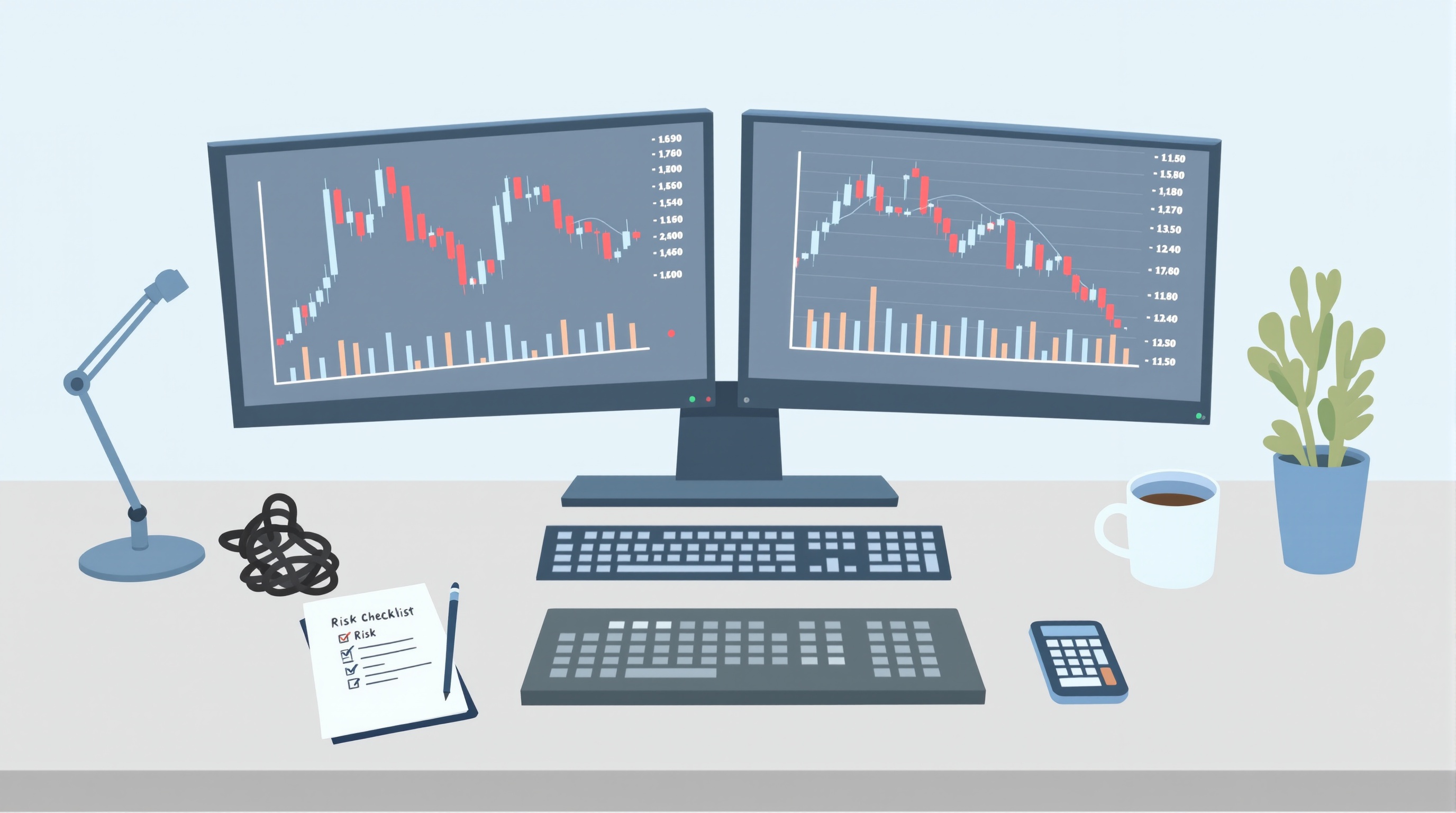
Understanding why most beginners lose at forex is the real starting point of Module 3, because no amount of chart-reading skill fixes a blown account. The good news: the causes are well known, mostly behavioural, and fixable with a few concrete habits you can start using on your very next trade.
This lesson builds on Module 2's position-sizing basics (if you haven't done that yet, go back before continuing) and assumes you already understand what a pip and a lot are. Here we focus on why the maths of risk, not the cleverness of a strategy, decides whether you're still trading in a year's time.
Why Beginners Lose At Forex: The Real Pattern
It's rarely one dramatic mistake. It's usually a combination that compounds:
- Risking too much per trade – often 5%, 10%, or more of the account on a single position
- No fixed stop loss, or moving it further away once the trade goes wrong
- Overtrading – taking trades out of boredom or FOMO, not because a plan called for it
- Revenge trading – doubling size after a loss to "win it back" quickly
- Ignoring costs – not checking spread, commission and swap before choosing a broker or a holding period
- No record-keeping – repeating the same mistake for months because there's no journal to reveal the pattern
Retail trading is genuinely hard, and industry data consistently shows most retail leveraged accounts lose money. That's not a reason to avoid trading; it's a reason to treat risk control as the actual skill you're learning, ahead of entries and exits. The traders who last are the ones who make losing small and boring, not the ones who never lose.
Position Sizing: The Fix That Matters Most
Position sizing is the single highest-leverage habit in this lesson. The principle: decide the percentage of your account you're willing to lose on a trade before you decide anything else.
A simple, common approach:
1. Pick a risk percentage per trade — commonly 0.5–1% for beginners 2. Set your stop loss based on the chart, not on how much you "feel like" risking 3. Calculate lot size so that if price hits your stop, you lose only that percentage 4. Never override the calculation because "this one feels certain"
Worked example (illustrative numbers, not advice):
| Account size | Risk % | £ at risk | Stop distance | Approx. position size | |---|---|---|---|---| | £1,000 | 1% | £10 | 20 pips | Small enough that 20 pips = £10 loss | | £5,000 | 0.5% | £25 | 30 pips | Sized so 30 pips = £25 loss |
The exact lot size depends on the pair and your broker's contract specifications — most platforms, including MetaTrader on a Pepperstone server or IG's own platform, have a built-in calculator or one is easy to find. The number itself matters less than the discipline of using one every time.
Stop Losses and Why "No Stop" Is the Classic Beginner Error
Trading without a stop loss feels like giving yourself room to be "right eventually." In practice it does the opposite: it turns a small, defined loss into an open-ended one, and it's the single most common way beginner accounts go to zero.
Set your stop when you open the trade, based on:
- Structure – beyond a recent swing high/low, not a round number
- Volatility – wide enough that normal noise doesn't stop you out early
- Your position size – so the £ amount at stop matches your risk plan
Then leave it alone. Moving a stop further away because the trade "just needs more room" is rarely a chart-based decision — it's usually an emotional one, and it's how a 1% planned loss becomes a 5% actual one.
Overtrading and Revenge Trading
Two behaviours account for a huge share of beginner losses beyond sizing:
- Overtrading: taking trades that don't meet your own criteria because you're bored, watching the screen too much, or trying to make "something" happen every day
- Revenge trading: increasing size or frequency straight after a loss to win it back fast
Both come from treating trading as an emotional outlet rather than a process. A practical fix: set a maximum number of trades per day or week, and a rule that after two consecutive losses you stop for the session. This isn't superstition — it interrupts the emotional spiral before it compounds into a much bigger loss.
Costs: The Quiet Reason Small Edges Disappear
Even a beginner with reasonable risk control can be undone slowly by ignoring costs. Spread, commission, and overnight swap are certain; your profit is not. Over hundreds of trades, cost differences add up materially.
Before opening a live account:
- Compare spread and commission structures across brokers, not just the headline "tight spreads" claim
- Check overnight swap rates if you plan to hold positions longer than a day
- Factor in how often you trade — a scalper feels costs far more than a swing trader
Run your own numbers through the cost tool at /audit.html rather than trusting marketing pages. It's built to compare real cost impact across brokers like Pepperstone and IG side by side, using your actual trade size and frequency.
Journaling: Seeing Your Own Mistakes
You can't fix a pattern you can't see. A simple journal — entry, exit, size, reason for the trade, and what actually happened — turns vague feelings ("I keep losing") into evidence ("I lose most often when I move my stop").
Track for at least 20–30 trades before drawing conclusions:
- Win rate and average win vs average loss
- How often you followed your own plan vs deviated
- Whether losses cluster after a previous loss (a revenge-trading signal)
This single habit reveals more about why beginners lose at forex, specifically you, than reading another ten strategy articles.
Building Your Own Beginner Risk Checklist
Before every trade, run through:
- [ ] Risk per trade is 0.5–1% of account, calculated, not guessed
- [ ] Stop loss is set at entry, based on structure
- [ ] This trade matches my written plan/criteria
- [ ] I haven't taken more than my daily trade limit
- [ ] I'm not trading to recover a previous loss
- [ ] I've checked broker costs for this pair and holding period via /audit.html
Print it, pin it, use it every time until it's automatic. Compare regulated brokers' conditions at /brokers/index.html once your risk process is solid — the broker choice matters, but it comes after the habits, not before them.
Understanding why beginners lose at forex isn't about finding a secret strategy — it's about accepting that risk control, cost awareness, and honest self-review are the actual job. Get those three right and you'll still face losing trades, but you'll be far less likely to face a blown account.
Key takeaways
- Most beginner losses come from behaviour and sizing, not from picking the wrong currency pair
- Risking a fixed small percentage per trade (commonly 0.5-1%) is what keeps you in the game long enough to learn
- A written stop loss and position size, set before you enter, removes the biggest source of beginner errors
- Spreads, commissions and swaps compound over hundreds of trades — check them with the cost tool before you pick a broker
- Overtrading and revenge trading after a loss are the fastest ways to turn a small setback into a blown account
- Keeping a simple trade journal for 20-30 trades will show you your real mistakes faster than any strategy tweak
Frequently asked questions
- What is the single biggest reason beginners lose money in forex?
- Poor risk management, not bad analysis. Most new traders risk far too much per trade, so a normal losing streak (which happens to everyone) wipes out a large chunk of the account before their edge, if they have one, gets a chance to play out.
- How much should a beginner risk per trade?
- A common starting point is 0.5-1% of account equity per trade. On a £1,000 account that's £5-£10 at risk, not £5-£10 per pip. This keeps individual losses small enough that a run of 5-10 losers doesn't end your account.
- Do spreads and commissions really matter that much for beginners?
- Yes, especially if you trade often. Costs are fixed and certain; profits are not. Use the cost tool at /audit.html to see how spread and commission choices at brokers like Pepperstone or IG affect your numbers before you commit capital.
- Is demo trading a waste of time?
- No, but it has limits. Demo trading is useful for learning platform mechanics and testing whether you can follow your own rules. It won't teach you the emotional pressure of real money, so treat it as step one, not proof you're ready to go live.
- Should beginners use a fixed stop loss on every trade?
- Yes. A stop loss set at trade entry, based on your position sizing plan, is one of the simplest ways to avoid the account-ending mistake of holding a losing trade and hoping it turns around.