Home › FX Trading School › Beginner
What Is the Forex Market and How Does It Work?
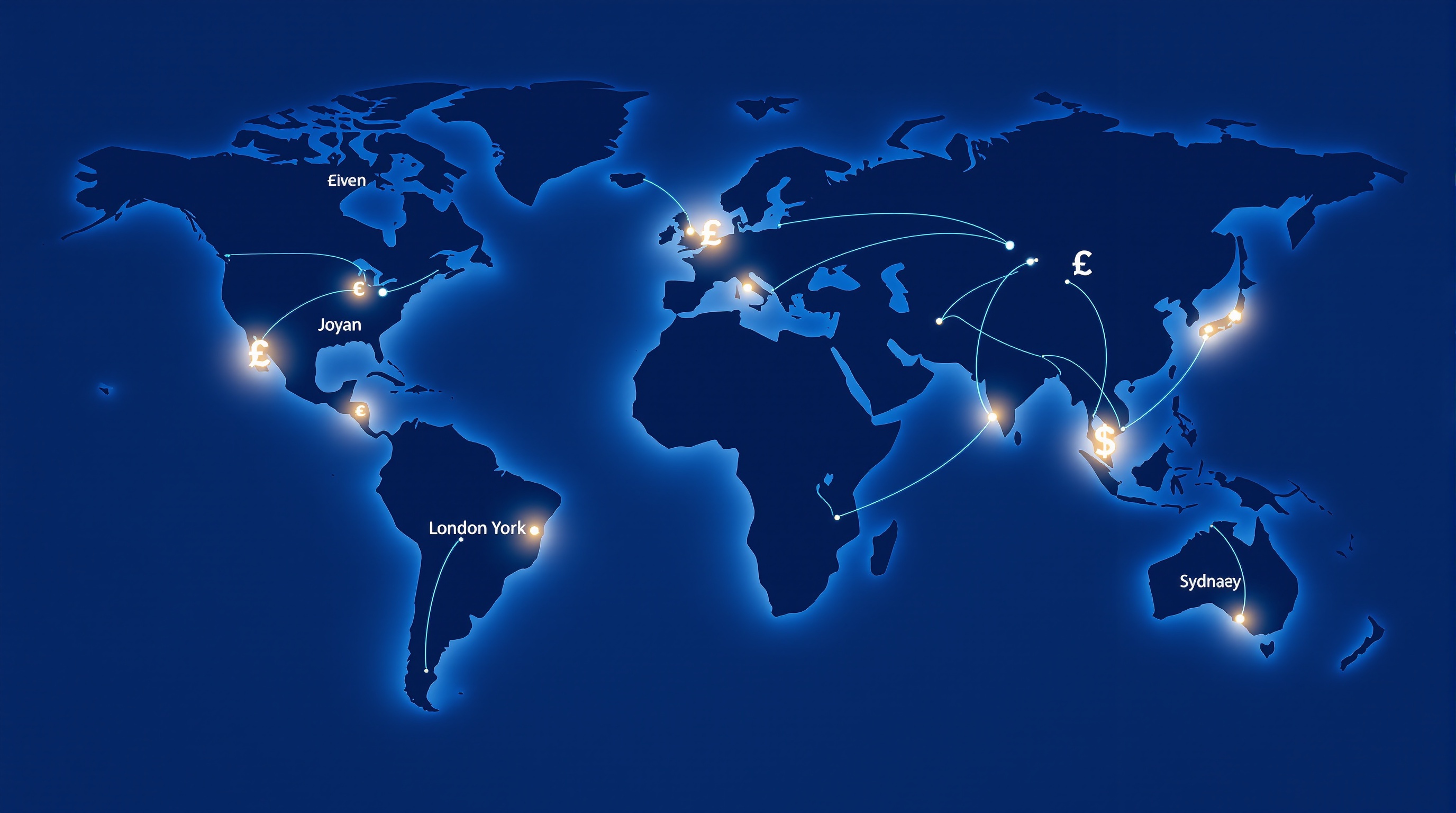
So what is the forex market, in plain terms? It's simply the global marketplace where one currency is exchanged for another — and it's the biggest, most liquid financial market in the world, trading trillions of dollars a day across almost every time zone. This lesson is Module 1 of the PipTax FX Trading School, and it's the foundation everything else builds on: before you look at charts, strategies, or costs, you need to understand what you're actually trading and who you're trading it with.
What Is the Forex Market, Really?
Forex (short for "foreign exchange") is the mechanism by which currencies are bought and sold against each other. There's no single physical exchange — unlike shares, which trade on the London Stock Exchange or NYSE, currencies trade over-the-counter (OTC), through a decentralised network of banks, brokers, and financial institutions.
Every trade involves a currency pair — you're always buying one currency and selling another simultaneously. For example:
- GBP/USD — pound sterling vs US dollar
- EUR/USD — euro vs US dollar
- USD/JPY — US dollar vs Japanese yen
The first currency is the "base," the second is the "quote." If GBP/USD is 1.2650, it means £1 buys $1.2650. That's the whole concept in a nutshell — everything else in this course is detail on top of that.
Who Actually Trades Currencies?
The forex market isn't just retail traders sat at home. It's a mix of participants with very different motives:
- Central banks — managing monetary policy and currency reserves
- Commercial banks and hedge funds — the majority of daily volume, often trading for clients or speculation
- Corporations — hedging currency risk from international business (an airline buying fuel in USD, for instance)
- Governments — managing trade and reserves
- Retail traders — individuals like you, trading through a broker
Retail volume is a small slice of the total market. That matters because it means prices are largely driven by institutional flow, not by retail sentiment — a useful reality check before you assume the market is "against you."
How Does Forex Trading Actually Work?
When you place a trade with a broker, you're speculating on whether a currency pair's price will rise or fall — you don't take physical delivery of currency. Here's the basic mechanics:
1. You choose a pair (e.g. EUR/USD) and a direction (buy or sell) 2. You choose a position size, often using leverage, which lets you control a larger position than your deposit alone 3. The broker quotes a price — usually as a bid (sell price) and ask (buy price), with the gap between them called the spread 4. You open and close the trade, and your profit or loss is the difference between entry and exit price, multiplied by your position size
Brokers like Pepperstone and IG offer access to this market either through their own platforms or via MetaTrader — for example, Pepperstone runs multiple MetaTrader server environments, while IG has its own proprietary platform alongside MT4. The mechanics of buying and selling are the same either way; what differs is execution style, available instruments, and — critically — cost, which we cover properly in later modules.
Why Does the Forex Market Trade 24 Hours a Day?
Because it's decentralised and global, the forex market follows the sun. As one financial centre closes, another opens:
| Session | Approx. UK Time | |---|---| | Sydney | 22:00 – 07:00 | | Tokyo | 00:00 – 09:00 | | London | 08:00 – 17:00 | | New York | 13:00 – 22:00 |
This means the market is open from Sunday evening to Friday evening (UK time), with no single closing bell. Liquidity isn't constant, though — it's highest when sessions overlap, particularly during the London/New York overlap. Later lessons in this school cover session timing in more detail, but for now, just know that *when* you trade affects spreads, volatility, and how easily orders fill.
Spot Forex vs Other Ways to Trade Currencies
Most retail brokers offer spot forex — trading the current market price with no fixed expiry. But it's worth knowing there are other structures:
- Spot FX — the standard retail approach; positions can be held open indefinitely (subject to overnight financing)
- Forex futures — standardised contracts traded on exchanges like the CME, with fixed expiry dates
- CFDs on currency pairs — common with UK brokers, letting you speculate on price movement without owning the underlying asset
Most beginners in the UK will be trading spot forex or FX CFDs through brokers such as Pepperstone or IG. Each structure has different cost implications — overnight swaps, financing rates, and commissions all vary — which is exactly why comparing real numbers matters more than assuming one broker is "cheap" because of headline spreads.
The Cost Side Nobody Talks About Enough
Understanding what the forex market is matters — but understanding what it *costs you to trade in it* matters just as much, and it's routinely glossed over by beginner content. Every trade carries some combination of:
- Spread — the gap between bid and ask
- Commission — a fixed or per-lot fee some brokers charge on top of spread
- Overnight swap/financing — the cost (or credit) of holding a position past the daily rollover
- Slippage — the difference between expected and actual execution price
These costs compound, especially for active traders. Don't take marketing claims about "tight spreads" at face value — run your own numbers using PipTax's [cost audit tool](/audit.html), and compare real broker conditions on the [brokers page](/brokers/index.html) before committing capital.
Getting Started the Honest Way
The forex market is genuinely global, genuinely liquid, and genuinely risky — most retail accounts lose money, and no amount of market understanding removes that risk entirely. What it does do is give you a realistic footing before you touch a demo account or real capital.
Before moving to Module 2, make sure you can:
- Explain what a currency pair is and identify base vs quote
- Describe why the market trades 24 hours a day
- Name the main participant types beyond retail traders
- Distinguish spot forex from futures and CFDs
This lesson answers *what is the forex market* at a conceptual level — the next modules in the PipTax FX Trading School build on this with how prices move, how leverage really affects risk, and how to compare true broker costs rather than headline numbers. Head to the [School index](/school/index.html) for the next lesson.
Key takeaways
- The forex market is a decentralised, over-the-counter global marketplace for exchanging currencies — there's no single physical exchange
- Every forex trade involves a currency pair; you're always buying one currency and selling another simultaneously
- The market runs 24 hours a day, Sunday evening to Friday evening UK time, following major financial centre sessions
- Retail traders are a small part of overall market volume compared to banks, hedge funds, and central banks
- Spot forex, futures, and CFDs are different structures for trading currencies, each with different cost implications
- Trading costs (spread, commission, swap) compound over time — always verify real numbers via a cost tool rather than marketing claims
Frequently asked questions
- Is forex trading the same as forex investing?
- Not really. Investing usually implies holding an asset for the long term expecting it to appreciate. Retail forex trading is typically short-to-medium term speculation on price movements, often using leverage, which carries a different and generally higher risk profile.
- Do I need a lot of money to start trading forex?
- Brokers often allow small minimum deposits, but position size and leverage determine your actual risk exposure, not your account balance alone. Starting small and using a demo account first is a sensible way to learn mechanics without risking real capital.
- Why do currency prices move?
- Prices move due to supply and demand driven by interest rate decisions, economic data, geopolitical events, central bank policy, and overall market sentiment. No single factor explains all movement, which is why forex is considered a complex market to trade.
- Is forex trading legal and regulated in the UK?
- Yes. UK retail forex/CFD trading is regulated by the FCA. Brokers such as Pepperstone and IG are FCA-authorised, which brings specific client protections, though regulation doesn't eliminate trading risk or losses.
- What's the difference between trading via MetaTrader and a broker's own platform?
- MetaTrader (MT4/MT5) is a widely used third-party platform offered by many brokers, including Pepperstone. Some brokers, like IG, also offer their own proprietary platform. The underlying market access is similar, but charting tools, order types, and execution can differ.
- How do I know if a broker's costs are competitive?
- Don't rely on headline spread advertising alone. Use a structured comparison of spread, commission, and swap costs for your actual trading style via PipTax's cost audit tool, and cross-check against current broker documentation before opening an account.