Home › FX Trading School › Pro
Using VWAP as a Professional Reference | FX School
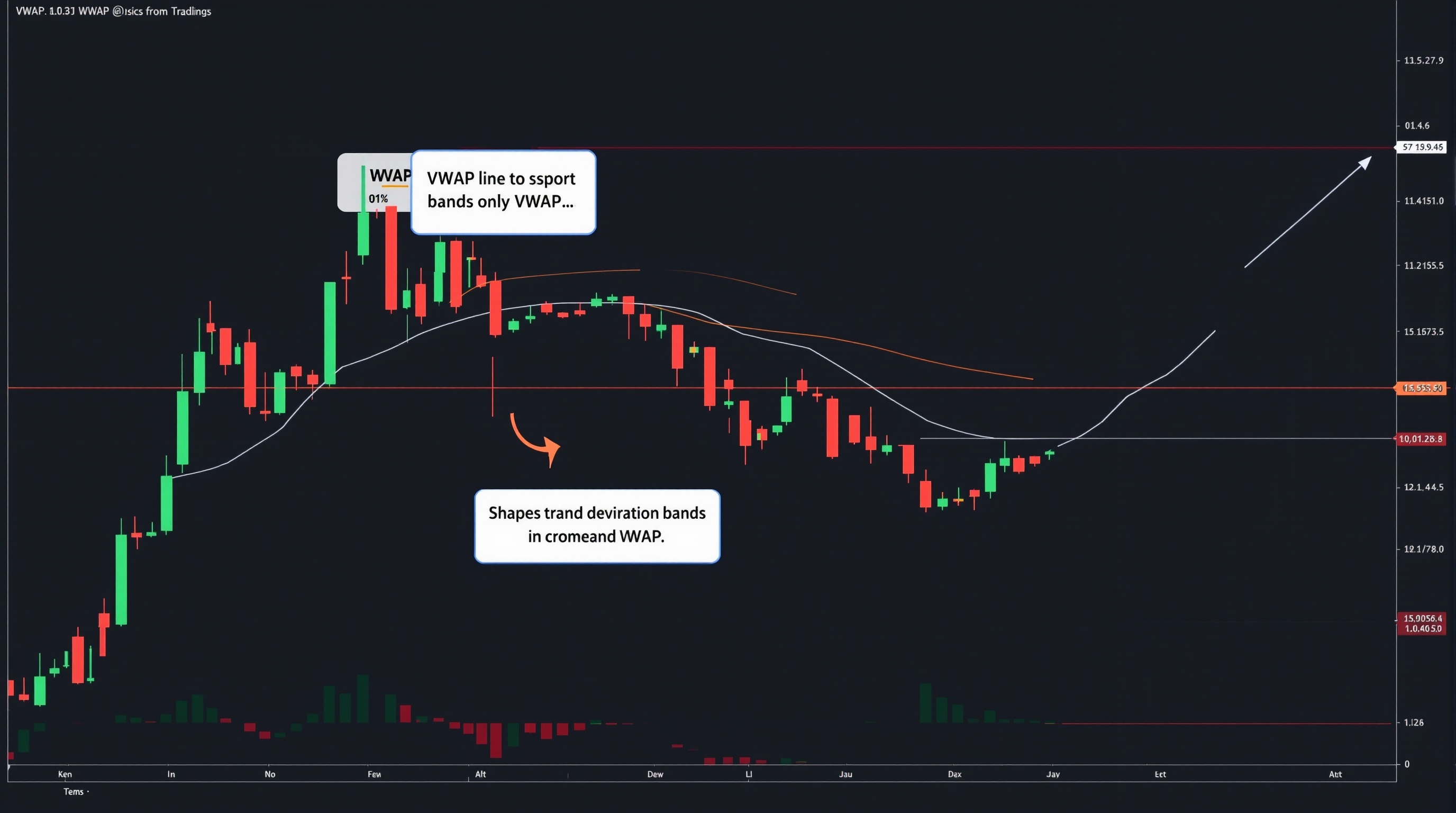
Using VWAP as a professional reference turns a line on your chart into a genuine institutional benchmark — the same one used by execution desks to judge whether a fill was good or bad. This lesson builds on Module 9's work on market structure and Module 10's session-based volatility profiles, so if those feel shaky, loop back before continuing.
What VWAP Actually Measures
VWAP stands for Volume-Weighted Average Price. It's not a moving average — it's a cumulative calculation that resets at a fixed point (usually the start of the trading day or session) and answers one question: at what average price has volume actually traded so far, weighting each price by how much was dealt there.
Key mechanical differences from a normal moving average:
- It resets. A 20-period EMA carries history forward forever; VWAP typically restarts each session, so it's meaningless without knowing the anchor point.
- It's volume-weighted, not time-weighted. A burst of volume at one price level pulls VWAP toward it far more than a quiet period at another price.
- Retail forex data is a proxy. True VWAP needs real traded volume. Spot FX has no central exchange, so retail platforms use *tick volume* (number of price changes) as a stand-in. It correlates reasonably well with activity but is not the same as futures or equity volume — worth knowing before you treat it as gospel.
Institutional desks use VWAP because a large order executed above VWAP (when buying) or below it (when selling) is, by definition, worse than the session average — that's literally how execution quality gets graded internally. Retail traders borrow the concept as a fair value reference, not an execution scorecard.
Why Professionals Treat VWAP as "Fair Value"
The core idea: price above VWAP means the average participant today is in profit if they bought; price below VWAP means the average buyer is underwater. This makes VWAP a rough proxy for who's in control of the session.
Practical uses professionals lean on:
- Mean reversion context — price stretched far from VWAP in a rangebound session often drifts back toward it as the day progresses.
- Trend confirmation — in a trending session, price holding consistently above (or below) VWAP without touching it back is a sign of one-sided control, not balance.
- Entry discipline — some desks won't chase a breakout unless price has already cleared VWAP, using it as a line in the sand between "still fair value" and "now extended."
None of this is a signal on its own. VWAP tells you *where average price sits*, not *where price is going*. Treat it the same way you'd treat a key structural level from Module 9 — as context that filters other setups, not a standalone trigger.
Setting Up VWAP Correctly on Your Platform
Getting the anchor and settings right matters more than which indicator you pick.
1. Choose your session anchor. For FX, the most common professional anchor is the start of the New York session or the UTC daily rollover — pick one and stay consistent. Some traders run separate VWAPs anchored to London open and NY open to see both sessions' fair value at once. 2. Confirm it resets. In MetaTrader (as offered on Pepperstone's MT4/MT5 servers), standard VWAP isn't built in — you'll need a verified custom indicator that resets on your chosen anchor. On IG's own platform, check whether VWAP is available as a native overlay and how its reset is defined before relying on it. 3. Check the volume source. Since it's tick volume in FX, cross-check with the deal ticket or platform docs so you know exactly what's being counted. 4. Match timeframe to purpose. Intraday VWAP (session-anchored) suits day trading; weekly or monthly anchored VWAP suits swing traders judging where the "average cost basis" of the bigger move sits.
Always test settings on a demo account first — an incorrectly anchored VWAP will quietly mislead you for weeks before you notice.
Reading VWAP Bands and Standard Deviations
Many VWAP tools plot standard deviation bands above and below the line — think of them as Bollinger Bands built around volume-weighted price instead of a simple average.
| Band | Typical use | |---|---| | VWAP line | Fair value / session average | | ±1 SD | Normal rotation zone — price spends most of the session here | | ±2 SD | Stretched — mean-reversion traders start watching for exhaustion | | ±3 SD | Rare — often session extremes, high conviction one-sided flow |
Bands compress in quiet, low-volume sessions and expand in high-volume, news-driven ones. A touch of the +2 SD band in a dead Asian session is a very different event to the same touch during a US CPI release — the underlying volatility context (Module 10) still governs how much weight to give it.
Where VWAP Falls Short in Retail FX
Be honest about the limitations before you build a strategy around this:
- No true consolidated volume — tick volume is a proxy, not the real thing, unlike VWAP's origins in equities and futures.
- Fragmented liquidity — different brokers see different flow, so VWAP calculated on Pepperstone's feed won't exactly match VWAP on IG's feed, even on the same pair.
- Anchor disputes — there's no single "correct" reset time in FX's 24-hour market, so two traders can legitimately disagree on what "today's VWAP" even is.
- Spread and execution costs still apply — a price sitting exactly on VWAP means nothing about your actual entry cost once spread, commission, or swap are factored in. Run your setup through PipTax's cost tool at /audit.html to see how execution costs affect the same VWAP-based entries and exits across different brokers.
Treat VWAP as one voice in the room, not the final word.
Building VWAP Into a Trading Plan
To use VWAP professionally rather than decoratively:
- Define your anchor and stick to it for at least 20 sessions before judging usefulness.
- Pair it with structure, not in isolation — a VWAP reclaim at a prior support level (Module 9) is stronger evidence than either signal alone.
- Journal every VWAP-based trade — note the anchor, band touched, and outcome, so you can review whether it's actually adding edge for your pairs and sessions.
- Compare across brokers before assuming a discrepancy is meaningful — check /brokers/index.html and /rates.html to understand how feed and volume differences might explain small VWAP gaps between platforms.
- Never trade VWAP alone — using VWAP as a professional reference means using it as *context*, alongside risk management and a clear invalidation level, not as a mechanical buy/sell trigger.
Conclusion
Using VWAP as a professional reference means understanding what it is (a volume-weighted fair-value line), what it isn't (a guaranteed reversal or breakout signal), and where its retail FX limitations lie — tick-volume proxies, fragmented broker feeds, and anchor disagreements all matter. Used carefully alongside structure and sound risk management, it's a genuinely useful layer of context; used blindly, it's just another line that looks smarter than it is. Trading carries real risk of loss, and no indicator — VWAP included — removes that.
Key takeaways
- VWAP is volume-weighted, resets on a session anchor, and differs fundamentally from a standard moving average.
- In retail FX, VWAP relies on tick volume as a proxy since there's no central exchange volume data.
- Professionals treat VWAP as a fair-value reference and execution benchmark, not a standalone buy/sell signal.
- Standard deviation bands around VWAP help gauge how stretched price is relative to the session average.
- VWAP will differ slightly between brokers like Pepperstone and IG due to different feeds — check /audit.html to see how execution costs interact with your entries.
- Combine VWAP with market structure and a trading journal before trusting it as part of your edge.
Frequently asked questions
- Is VWAP the same as a moving average?
- No. A moving average is time-weighted and rolls forward continuously, while VWAP is volume-weighted and resets at a fixed anchor point such as session open. They can look similar visually but are calculated very differently.
- Does VWAP work reliably in forex trading?
- It works as a useful reference, but retail FX VWAP relies on tick volume rather than true consolidated volume, since spot FX has no central exchange. Treat it as a helpful proxy, not an exact institutional metric.
- Will VWAP look different on Pepperstone vs IG?
- Yes, slightly. Each broker's feed reflects its own liquidity and tick data, so VWAP calculated on Pepperstone's MetaTrader servers won't exactly match VWAP on IG's own platform, even for the same currency pair.
- Can I use VWAP alone to trade breakouts or reversals?
- It's not recommended. VWAP shows where average price has traded, not where price is heading next. Pair it with market structure, a clear invalidation level, and proper risk management rather than using it in isolation.
- What VWAP anchor should I use for day trading?
- Most day traders anchor VWAP to the session open they care about most, often New York or the UTC daily rollover. Pick one anchor, stay consistent for at least 20 sessions, and journal the results before judging its usefulness.