Home › FX Trading School › Advanced
Volatility Targeting and Drawdown Control
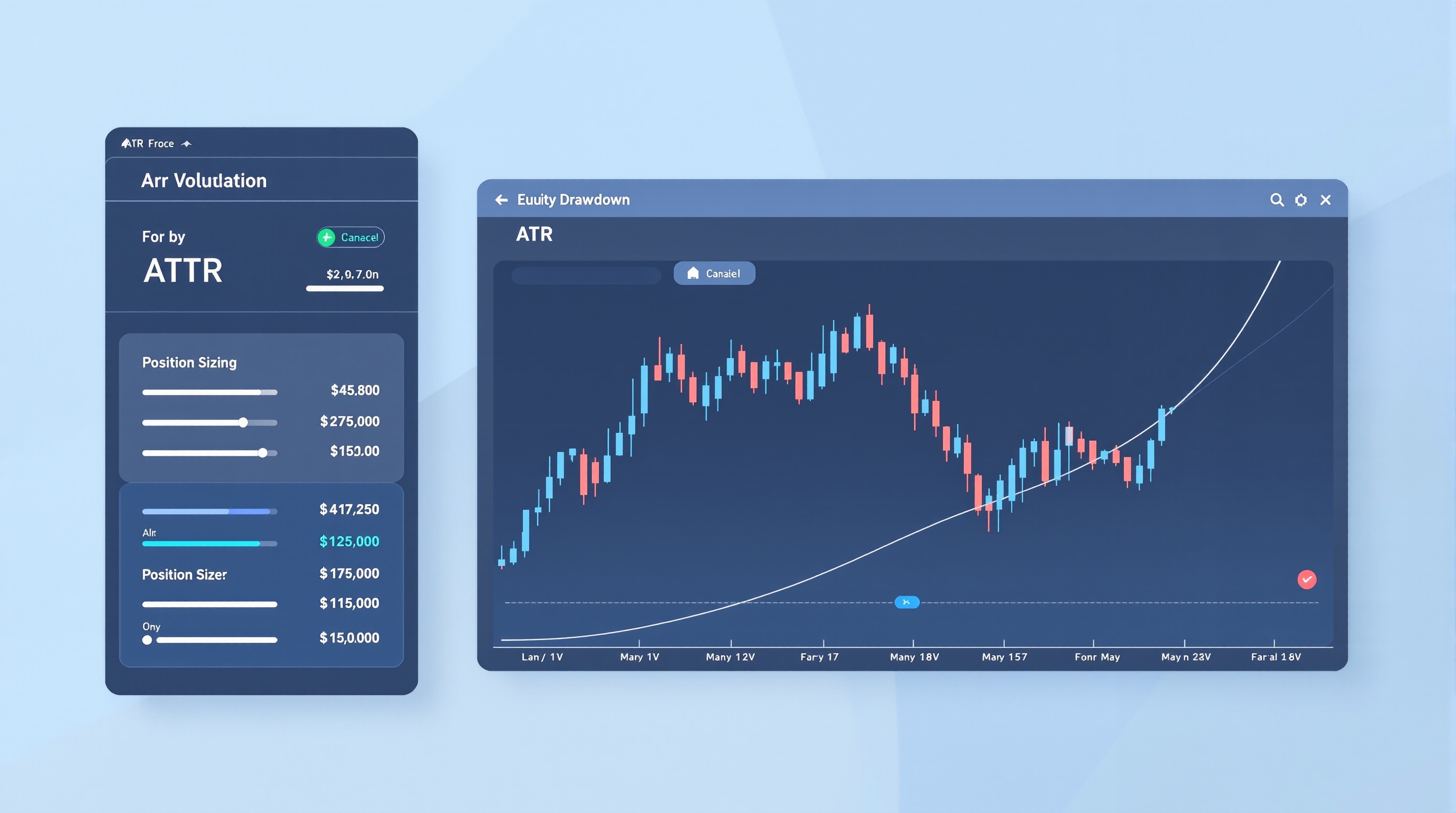
Volatility targeting is how professional traders decide position size before they decide direction — sizing each trade so it carries roughly the same amount of risk regardless of how calm or wild the market currently is. This lesson builds on Module 12's position-sizing basics and Module 17's risk-per-trade rules, and pushes them further into a full framework for controlling drawdown at the portfolio level.
By this stage in the course you should already be comfortable calculating position size from a fixed percentage risk and a stop-loss distance. Volatility targeting adds a second layer: it adjusts that sizing dynamically as market conditions change, so your equity curve doesn't swing wildly just because EURUSD suddenly started moving twice as fast.
What volatility targeting actually means
The core idea is simple: risk should scale inversely with volatility. If a pair's daily range doubles, your position size should roughly halve to keep dollar risk constant. Without this adjustment, a strategy that looked stable in quiet markets can suddenly produce outsized losses the moment volatility spikes — which is exactly when most drawdowns happen.
Practically, this means:
- Measuring volatility with something consistent — Average True Range (ATR) over 14 or 20 periods is the industry default.
- Setting a target risk per trade (e.g. 0.5–1% of equity), then sizing the position so that a stop placed at 1.5–2x ATR equals that risk in account currency.
- Recalculating position size before every new trade, not just at the start of the week.
The formula is straightforward:
`
Position size = (Account equity × Risk %) ÷ (Stop distance in pips × Pip value)
`
Where stop distance is derived from current ATR, not a fixed number of pips. This is the mechanical link between volatility and size — get comfortable with it, because everything else in this lesson builds on it.
Why fixed lot sizes quietly break your risk plan
A trader who always uses 1 standard lot on GBPUSD is implicitly taking wildly different risk depending on conditions. Compare two weeks:
| Condition | ATR (14) | Stop (2x ATR) | Risk at 1 lot fixed | |---|---|---|---| | Quiet range | 40 pips | 80 pips | Moderate | | News-driven volatility | 110 pips | 220 pips | ~2.75x larger |
The fixed-lot trader has no idea their risk nearly tripled — until the drawdown shows it. This is the single most common reason disciplined-looking traders still blow through their max drawdown limits: their sizing was never actually constant, it just looked constant on the ticket.
Volatility targeting fixes this by making the stop distance and the position size move together, so the dollar risk stays flat even as pip risk changes. It doesn't reduce how often you're wrong — it reduces how much a run of bad luck can cost you.
Building a volatility-targeted position size
Here's a practical, repeatable workflow you can run before every trade:
1. Pull current ATR (14-period, daily or the timeframe you trade) for the pair. 2. Set your stop multiple — commonly 1.5x to 2x ATR, decided in advance, not adjusted per trade based on feel. 3. Convert to account currency risk using your broker's pip value for that pair and your position size. 4. Solve for lot size using the formula above, targeting your fixed risk percentage. 5. Round down to your broker's minimum lot increment — never round up to "make the trade feel bigger."
Both Pepperstone and IG publish contract specifications and pip values per instrument, which you'll need for step 3 — check these directly on their platforms rather than assuming they're identical to another broker's, since specs can vary by account type and instrument. If you're testing this on a demo, IG's own platform and Pepperstone's MetaTrader servers both show live ATR values directly on the chart, so there's no need for a separate calculator once you've built the routine.
Drawdown control: the portfolio-level layer
Volatility targeting controls single-trade risk. Drawdown control is the layer above it — rules that reduce or halt trading once losses reach a threshold, regardless of how good any individual setup looks.
A basic drawdown control framework:
- Soft stop at -5% equity: cut position sizes by half until equity recovers to a new high.
- Hard stop at -10% equity: stop trading entirely, review the last 20 trades for a pattern before resuming.
- Correlation check: don't let three "different" trades that are all really long-USD count as three independent risk units — they're one concentrated bet.
- Time-based cooling off: after a hard stop, a mandatory 48-hour pause before re-entering, to separate decisions from emotion.
These thresholds aren't universal — a prop-style account with strict daily limits will set them tighter than a personal account with a longer time horizon. What matters is that the rule exists before the drawdown happens, written down, not improvised mid-loss.
Putting the two together: a worked example
Say your account is £20,000, your risk target is 0.75% per trade (£150), and you're trading EURUSD with a 14-period ATR of 55 pips, stop set at 2x ATR (110 pips).
- Risk per trade: £150
- Stop distance: 110 pips
- Required pip value: £150 ÷ 110 = £1.36 per pip
- That determines your lot size given the pair's standard pip value per lot
Now assume ATR doubles to 110 pips overnight after a central bank surprise. Your stop widens to 220 pips, and your position size automatically halves to keep the same £150 risk. No manual override, no gut-feel resizing mid-panic — the volatility target does it for you.
If that trade still loses, your drawdown control layer tracks the running total. Three losses in a row at 0.75% each is roughly -2.25% — nowhere near your soft-stop threshold, so trading continues normally. This is the point: the system should absorb normal losing streaks without triggering emergency measures, while still catching genuine tail-risk events.
Common mistakes at this level
Even experienced traders trip up applying volatility targeting in practice:
- Recalculating too rarely — using stale ATR values from the start of the week rather than the current session.
- Ignoring correlation — volatility-targeting five USD pairs individually while treating them as unrelated risk.
- Adjusting the multiplier emotionally — widening the ATR multiple after a loss to "give the trade more room" defeats the entire purpose.
- Forgetting costs — spreads, commissions and swaps eat into effective risk and returns differently across brokers; run your actual setup through PipTax's cost tool at /audit.html rather than assuming two brokers are equivalent.
- No hard stop at all — a volatility-targeted system without a drawdown ceiling still allows unlimited cumulative loss.
Conclusion
Volatility targeting and drawdown control together form the backbone of professional-grade risk management: one keeps every trade's risk consistent as conditions change, the other keeps a bad run from becoming account-ending. Neither guarantees profit — trading remains risky, and most retail accounts lose money — but both make your losses predictable and bounded, which is the only realistic edge most traders can build.
Before applying this live, compare how your broker's actual spreads and commissions interact with your ATR-based stops using /audit.html, and check current instrument specs on /brokers/index.html for Pepperstone, IG or whichever broker you use.
Key takeaways
- Volatility targeting sizes each trade inversely to current ATR so dollar risk stays constant as market conditions change
- Fixed lot sizing quietly changes your real risk every time volatility shifts, even if the ticket looks identical
- Use a 1.5x–2x ATR stop multiple set in advance, then solve position size backwards from your fixed risk percentage
- Drawdown control adds portfolio-level rules — soft stops, hard stops, correlation checks — that volatility targeting alone doesn't cover
- Recalculate ATR before every trade rather than using stale weekly values, and always check correlated exposure across 'different' trades
- Trading remains risky regardless of sizing discipline; use /audit.html to see how real broker costs interact with your stops
Frequently asked questions
- What is volatility targeting in forex trading?
- Volatility targeting is a position-sizing method that adjusts trade size inversely to current market volatility, usually measured by ATR, so that dollar risk stays roughly constant whether the market is quiet or fast-moving.
- How do I calculate position size using ATR?
- Set a fixed risk percentage of equity, multiply current ATR by your chosen stop multiple (typically 1.5x–2x) to get stop distance in pips, then divide your risk amount by that stop distance and the pip value to solve for lot size.
- What's the difference between volatility targeting and drawdown control?
- Volatility targeting manages risk on individual trades by adjusting size to conditions. Drawdown control operates at the portfolio level, using rules like soft stops and hard stops to reduce or halt trading once cumulative losses hit a threshold.
- Do Pepperstone and IG offer the ATR indicator needed for this?
- Yes — both IG's own platform and Pepperstone's MetaTrader servers display ATR directly on the chart, so you can pull the current value without a separate tool. Always confirm pip values and contract specs on their platforms directly.
- How often should I recalculate my position size?
- Before every new trade, using the current ATR reading rather than a value from earlier in the week. Volatility can shift significantly within days, especially around news events.
- Can volatility targeting guarantee smaller drawdowns?
- No. It reduces the chance that a single volatile trade causes disproportionate damage, but it cannot prevent losing streaks or eliminate risk. Trading is inherently risky and most retail accounts lose money.