Home › FX Trading School › Advanced
Systematic Trading Strategy Design: A Complete Framework
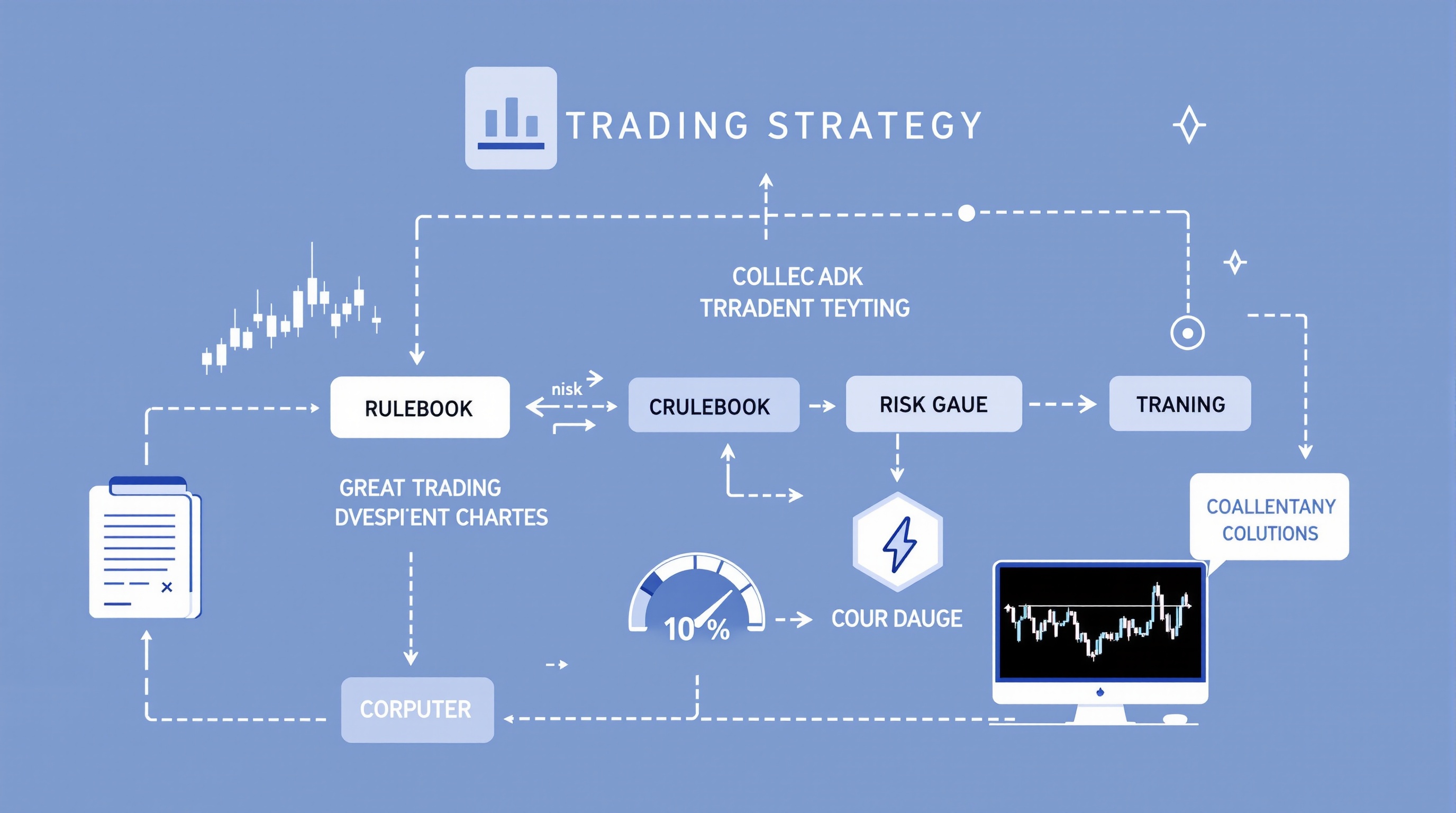
Building a systematic trading strategy means turning a trading idea into a fixed set of rules that you can test, measure, and run without second-guessing every decision. This module assumes you've already covered position sizing and risk-of-ruin (Module 9) and backtesting fundamentals (Module 12) — if either feels shaky, go back before continuing, because everything here builds on both.
A systematic approach is not about finding a "holy grail" indicator. It's an engineering exercise: define the edge, prove it survives real-world friction, size it sensibly, and only then let it touch a live account. Most retail traders skip straight to the last step. This lesson is about not doing that.
What a Systematic Trading Strategy Actually Requires
At its core, a systematic trading strategy needs five things written down in unambiguous language — no room for interpretation:
- Entry conditions — the exact price/indicator state that triggers a trade
- Exit conditions — stop loss, take profit, and any time-based or trailing exit
- Position sizing rule — how size is calculated from account equity and stop distance
- Market/session filter — which instruments and hours the system is allowed to trade
- Invalidation rule — the condition under which you stop trading the system entirely
If you can't code or clearly script each of these, it isn't systematic yet — it's discretionary trading wearing a systematic costume. A useful test: could someone else follow your rules and get the same trades you would? If not, tighten the language.
Write this as a one-page "strategy spec" before you touch a chart. It forces precision and gives you a fixed reference point later when live results start to drift from expectations — which they will, to some degree.
Sourcing and Stress-Testing the Edge
Every systematic strategy needs a hypothesis for *why* it should work — mean reversion after an overextension, momentum continuation, a session-open volatility pattern, a carry bias. Without a reason, you're just curve-fitting historical noise.
Once you have a hypothesis:
1. Backtest on out-of-sample data — split your history so the rules are built on one period and tested on another you didn't peek at. 2. Check regime dependence — does it only work in trending 2020-style markets, or also in the choppy ranges of 2023? 3. Run a walk-forward test — re-optimise periodically on a rolling window to see if performance holds up rather than being a one-off fit. 4. Stress the parameters — nudge your moving average length or stop multiple by 10–20%. If results collapse, the edge was fragile, not real.
Be honest about sample size. A strategy with 40 trades over three years tells you very little. Aim for statistically meaningful trade counts before drawing conclusions, and always keep a slice of data completely untouched until the very end, as a final honesty check.
Modelling Execution Costs Before You Trust a Backtest
This is where most amateur systems fall apart in live trading. A backtest that ignores spread, commission, and slippage isn't testing your strategy — it's testing a fantasy version of it.
Build cost into every simulated trade:
| Cost component | Why it matters | |---|---| | Spread | Paid on every entry and exit, compounds with trade frequency | | Commission | Fixed per lot on ECN/raw accounts — matters more for scalping systems | | Slippage | Worse during news or thin liquidity; model it, don't ignore it | | Swap/rollover | Relevant for strategies holding positions overnight |
A high-frequency mean-reversion system might look brilliant gross of costs and marginal — or negative — net of them. Rather than guessing at figures, run your actual instrument list and expected trade frequency through PipTax's cost tool at [/audit.html](/audit.html) to see how spread and commission structures compare across account types. If you're deciding between a standard and raw-spread account at a broker like Pepperstone or IG, this is the step that answers it, not gut feel.
Position Sizing and Risk Controls
A systematic strategy without a sizing rule isn't finished — sizing is where theoretical edge becomes real account risk. Building on Module 9's risk-of-ruin concepts, your system needs:
- A fixed risk-per-trade percentage (commonly 0.5–1% of equity for systematic approaches, kept deliberately conservative)
- A maximum concurrent risk cap across correlated positions (e.g. don't let three EUR pairs all risking 1% each become a hidden 3% single-direction bet)
- A daily or weekly loss limit that pauses the system rather than lets a bad patch spiral
- A maximum drawdown trigger that forces a full review, not just a shrug
None of this is optional dressing. A strategy with a genuine edge can still ruin an account if sizing is reckless, and a mediocre edge can survive for years if sizing is disciplined. Sizing rules should be tested in the same backtest as your entries and exits — not bolted on afterwards.
From Backtest to Live: Forward Testing and Deployment
Never go from backtest straight to a funded live account. Insert a forward-testing stage:
1. Demo or micro-lot live testing for at least several weeks, ideally covering different market conditions 2. Compare live fills to backtest assumptions — check your assumed spread and slippage against what actually happened 3. Automate where possible — reduces the temptation to override rules mid-drawdown, which quietly destroys the "systematic" part 4. Log everything — every trade, every rule trigger, every manual override (there should be none)
Platform choice matters here too. If you're running an EA on MetaTrader, check execution model and server details — Pepperstone's MetaTrader server list, for instance, shows you exactly which server type you're connecting to, which affects fill quality. If you're trading manually on IG's own platform versus MetaTrader, compare order types and execution speed before assuming they behave identically.
Reviewing and Retiring a Systematic Trading Strategy
Markets change, and no systematic trading strategy works forever. Build a review cadence into the design from day one:
- Monthly: check live performance against backtest expectations (win rate, average R, drawdown)
- Quarterly: reassess whether the original market hypothesis still holds
- Immediately: if the max drawdown trigger fires, stop and review before resuming
- Annually: full re-backtest including the latest year of data, treating it as fresh out-of-sample evidence
Retiring a strategy isn't failure — it's the system doing its job. A predefined invalidation rule, set before you ever risk real money, removes the emotional difficulty of deciding "is this still working?" mid-drawdown. Compare live broker costs periodically too, since fee structures do change; the [/brokers/index.html](/brokers/index.html) comparison and [/rates.html](/rates.html) are worth a scheduled check alongside your strategy review, not just at setup.
Conclusion
Designing a systematic trading strategy end to end is a discipline of writing precise rules, testing them honestly against real costs, sizing risk conservatively, and reviewing performance on a fixed schedule — not a search for a system that never loses. Every stage above, from the strategy spec to the drawdown trigger, exists to remove guesswork and emotion from decisions that are far harder to make well in the moment. Trading remains genuinely risky and most retail accounts lose money even with a sound process, so treat systematic design as risk management first and profit-seeking second.
Key takeaways
- A systematic trading strategy must have written, unambiguous rules for entries, exits, sizing, filters, and invalidation before it touches a live account.
- Backtests must include realistic spread, commission, and slippage — use PipTax's cost tool at /audit.html rather than assuming gross backtest results will hold live.
- Position sizing and drawdown limits are part of the strategy design itself, not an afterthought bolted on after finding an edge.
- Always forward-test on demo or micro-lots before scaling up, and check live fills against backtest assumptions.
- Review performance on a fixed schedule and define retirement criteria in advance, since no strategy works forever.
- Trading remains risky and most retail accounts lose money, even with a disciplined systematic process.
Frequently asked questions
- Do I need to know how to code to build a systematic trading strategy?
- Not necessarily, but you need enough precision to remove ambiguity from every rule. Some traders script entries manually with strict checklists; others use MetaTrader's MQL or third-party backtesting platforms. The key requirement is that the rules are fixed and repeatable, not the tool used to enforce them.
- How much historical data do I need to backtest a strategy properly?
- There's no fixed number, but you want enough trades to be statistically meaningful — often several hundred rather than a few dozen — and enough calendar time to cover different market regimes (trending, ranging, high and low volatility). A strategy tested only on one strong trending year is largely untested.
- Why does my backtest look profitable but my live results don't match?
- The most common cause is under-modelling execution costs — spread, commission, and slippage. Re-run your backtest with realistic cost assumptions using PipTax's cost tool, and compare your actual live fills against what the backtest assumed, since a gap here is very common.
- How do I choose position size for a new systematic strategy?
- Start conservatively, commonly risking 0.5–1% of equity per trade, and build in a cap on total correlated exposure across open positions. Test the sizing rule inside your backtest rather than adding it as an afterthought, and revisit Module 9 on risk-of-ruin if this isn't already second nature.
- Should I trade a systematic strategy on MetaTrader or a broker's own platform?
- It depends on the strategy. Automated systems generally need MetaTrader or a similar platform that supports EAs — Pepperstone's MetaTrader server details are worth checking for execution model. Manually-run systematic rules can work fine on a platform like IG's own software, but compare order types and fill behaviour before assuming parity.
- When should I stop trading a systematic strategy?
- Ideally you define this before going live: a maximum drawdown trigger, a set number of consecutive losing months beyond backtest expectations, or evidence the original market hypothesis no longer holds. Reviewing this on a fixed schedule removes the emotional guesswork of deciding mid-drawdown.