Home › FX Trading School › Advanced
Systematic Trading: Moving On From Discretionary Calls
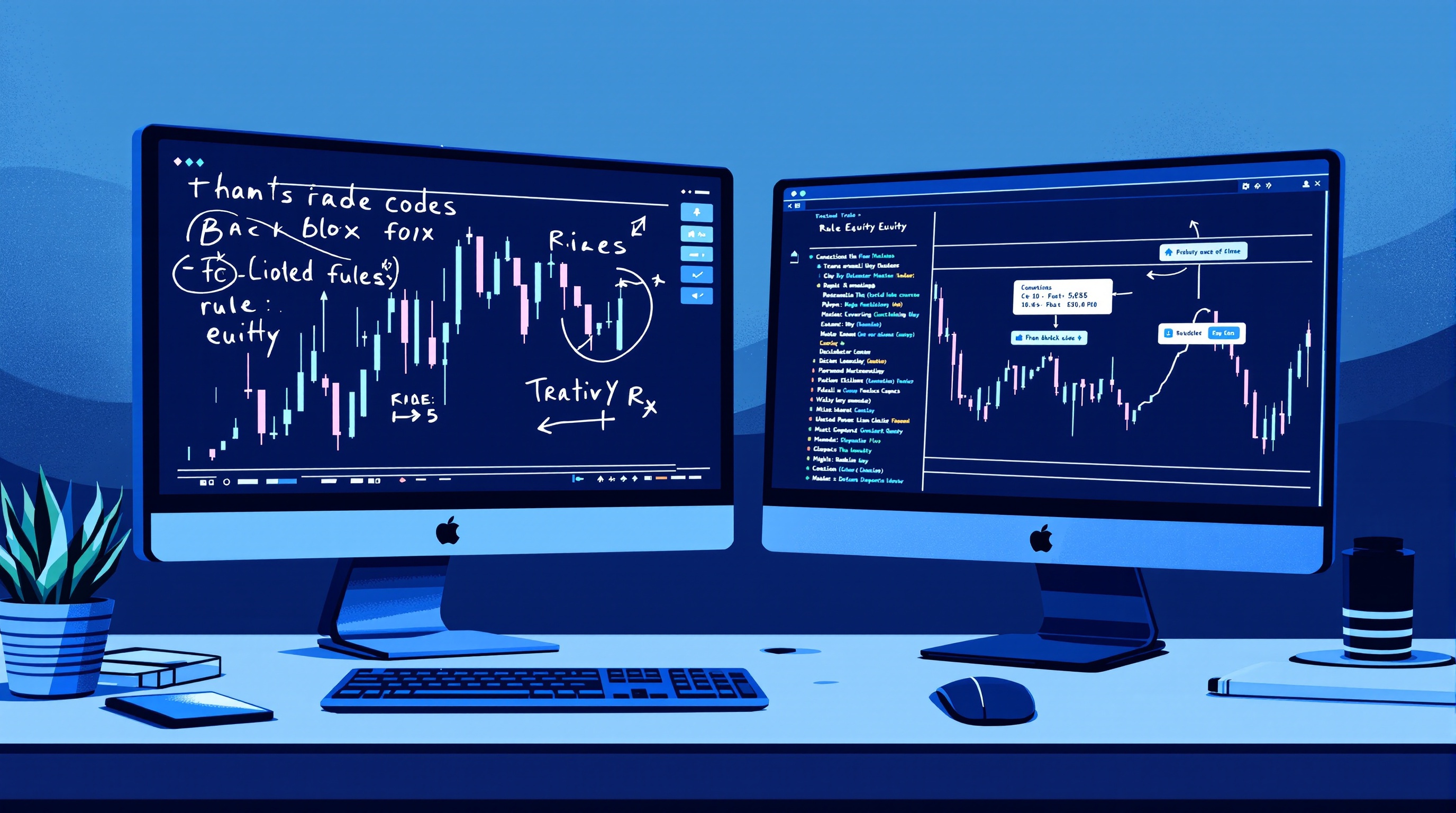
Systematic trading replaces gut-feel decisions with a fixed set of rules you write down, test, and follow the same way every time — and for traders who've spent years reading price action on instinct, that shift is harder than it sounds. This lesson is Module 20 of PipTax FX Trading School's Mastery tier, and it assumes you're already comfortable with position sizing, risk-per-trade discipline, and keeping a trade journal (Module 12). If those aren't second nature yet, go back before continuing — systematic trading amplifies whatever habits you already have, good or bad.
Why Discretionary Traders Hit a Ceiling
Discretionary trading isn't inherently wrong. Some traders read order flow, news reaction and market structure genuinely well. The problem is consistency and scalability:
- You can't fully audit it. If every trade involves "it felt right," you can't separate skill from luck across a sample of trades.
- It doesn't scale emotionally. The same trader who calmly takes a loss on a demo account often hesitates, moves stops, or doubles size after a losing streak on a live account.
- It resists improvement. You can't A/B test a feeling. Systematic rules let you change one variable at a time and measure the effect.
Traders usually reach for systematic methods after noticing a pattern: their planned trades work reasonably well, but their "gut call" trades — the ones outside the plan — lose money as a group. That's the tell. If you haven't checked this in your own journal, do it before building anything new.
What "Systematic" Actually Requires
A rule only counts as systematic if a second person, or a piece of code, could execute it identically without asking you anything. That means specifying:
- Entry trigger — an exact condition (e.g., 20-period EMA crosses above 50-period EMA on the close of a 4-hour candle), not "looks like a breakout."
- Stop loss placement — a fixed distance, ATR multiple, or structural level defined in advance, not "wherever feels safe."
- Position size — calculated from account risk percentage and stop distance, never eyeballed.
- Exit/take-profit logic — including what happens on partial fills, gaps, or missed exits.
- Filters — session times, news blackout windows, correlation limits between open positions.
If any of these still say "use judgement," you're not systematic yet — you're discretionary with extra steps. That's fine as a stage, but be honest about which one you're actually running.
Backtesting Without Fooling Yourself
Backtesting is where most systematic ambitions quietly fail, usually from optimism rather than dishonesty. Common failure points:
1. Unrealistic costs. Testing with zero spread or a flat notional commission that doesn't match what you'd actually pay. Use PipTax's cost tool at [/audit.html](/audit.html) to model realistic spread and commission assumptions for the instruments and account type you intend to trade. 2. Curve fitting. Tweaking rules until the backtest looks great is fitting noise, not finding an edge. A rule set with 15 adjustable parameters tested on 18 months of data is decoration, not evidence. 3. Survivorship in your own memory. Discretionary traders often "backtest" by scrolling a chart and spotting winning setups they remember. That's not a backtest — it's confirmation bias with a chart attached. 4. No out-of-sample data. Split your history: build rules on one period, test unchanged on a separate period you didn't look at while building.
A basic comparison table helps frame what you're checking for:
| Check | Discretionary habit | Systematic requirement | |---|---|---| | Entry | "Looks right" | Numeric trigger, backtested | | Costs | Ignored or guessed | Modelled from real spread/commission data | | Sample size | A few memorable trades | Hundreds of signals, multiple regimes | | Review | Vague feeling of "it's working" | Logged win rate, expectancy, drawdown |
Forward Testing on a Real Broker Environment
Backtests use historical data; forward testing checks whether your rules survive contact with live execution. This matters because fills, spreads and requotes differ by broker, account type, and even server.
Practical steps:
- Match your test environment to your live one. If you plan to trade on Pepperstone's MetaTrader servers, forward test on that same account type — a Standard account behaves differently from a Razor/raw-spread account in terms of spread and commission structure.
- If you'll trade on IG's own platform rather than MetaTrader, check whether your systematic rules can even be automated there, or whether you'll be executing them manually against IG's own charts and order tickets.
- Run in parallel, not in isolation. Forward test alongside your existing discretionary trading for a defined period (e.g., 3 months) rather than switching everything overnight.
- Log slippage separately from strategy performance. If your live fills are consistently worse than backtest assumptions, that's an execution problem, not a strategy problem — check current terms on the relevant broker page before concluding the strategy failed.
For live spread and commission figures on either broker, don't guess — check [/brokers/index.html](/brokers/index.html) and run the numbers through the cost tool before committing capital.
Managing the Psychological Transition
Ironically, systematic trading still requires discipline — just a different kind. Discretionary traders moving to rules-based methods commonly struggle with:
- Rule fatigue — following a system through a losing streak that "feels wrong" even though it's within expected variance.
- Silent overrides — skipping a signal "just this once," which quietly turns a systematic strategy back into a discretionary one with worse record-keeping.
- Over-monitoring — checking a systematic strategy every five minutes achieves nothing except stress; the whole point is that the rules don't need your live judgement.
Keep a separate log of every override, however small. If overrides outnumber followed signals, you haven't actually gone systematic — you've just added a rulebook you consult occasionally.
Building a Realistic Transition Plan
You don't need to flip a switch. A structured transition over several months is more honest and more sustainable:
1. Month 1–2: Write full rules for one existing discretionary strategy you already trade well. Backtest with realistic costs from [/audit.html](/audit.html). 2. Month 3–4: Forward test on demo, same broker/account type you'll trade live, logging every signal and every override. 3. Month 5–6: Trade a reduced size live, systematic rules only, alongside your existing discretionary account, reviewed weekly. 4. Ongoing: Increase systematic allocation only after a full quarter of rule-following with documented expectancy, not gut feel.
This is slower than most traders want, but systematic trading's entire value proposition — consistency and testability — depends on actually following the rules long enough to trust the data.
Conclusion
Systematic trading isn't a magic upgrade over discretionary skill — it's a discipline that trades flexibility for measurability, and it only works if the rules are specific enough to test and honest enough to follow through losing streaks. Trading remains risky either way, and most retail accounts still lose money regardless of method; a system reduces certain behavioural errors, it doesn't remove market risk. Before scaling any systematic strategy, confirm your cost assumptions are realistic using PipTax's tools, and revisit the course structure at [/school/index.html](/school/index.html) if any prerequisite ideas — risk sizing, journaling, cost modelling — need reinforcing first.
Key takeaways
- Systematic trading means every entry, exit and size decision follows a written rule you could hand to someone else to execute
- Most traders don't need to choose 100% systematic or 100% discretionary — a hybrid with hard systematic risk rules is a realistic middle ground
- Backtesting only tells you a rule set worked in the past under the costs you modelled — spreads, commissions and slippage must be realistic, not optimistic
- Moving to rules-based trading exposes hidden discretionary habits like moving stops or skipping signals, which a trade journal will reveal
- Broker execution quality (server, fill speed, requotes) affects a system's real-world results, so test on the same account type and server you'll trade live
- Use PipTax's cost tool and broker pages to model realistic costs into your backtest rather than guessing
Frequently asked questions
- Do I have to fully automate my strategy to be systematic?
- No. Systematic trading means your decisions follow fixed, written rules — it doesn't require an algorithm executing trades for you. Many traders run systematic rules manually, checking a checklist before every entry and exit. Automation is a separate step that some systematic traders never take.
- How long should I backtest before trading a system live?
- There's no fixed number, but advanced traders typically want several hundred trade signals across varied market conditions (trending, ranging, high and low volatility) before drawing conclusions. A system that only worked in one 2023 trend is not proven — it's a curve-fitted story.
- What's the biggest mistake traders make moving from discretionary to systematic?
- Writing rules loose enough to still allow discretionary override. If your rule says "enter near support with confirmation," that's not systematic — it's discretionary trading wearing a systematic costume. Rules need numbers: exact levels, exact indicator values, exact position sizes.
- Can I keep some discretionary trading alongside a systematic approach?
- Yes, and many experienced traders do, but it should be a deliberate structural choice — for example, a fixed percentage of capital in systematic strategies and a separate, smaller discretionary account. Mixing the two in one account without clear boundaries makes performance impossible to evaluate honestly.
- Does forward testing on a demo account really predict live results?
- It's useful but imperfect. Demo fills, especially on some MetaTrader demo servers, can be more generous than live execution. Forward test on the same broker and account type you intend to trade live, and expect live slippage and spreads to be somewhat worse than demo.