Home › FX Trading School › Pro
Slippage & Execution Quality: Pepperstone vs IG
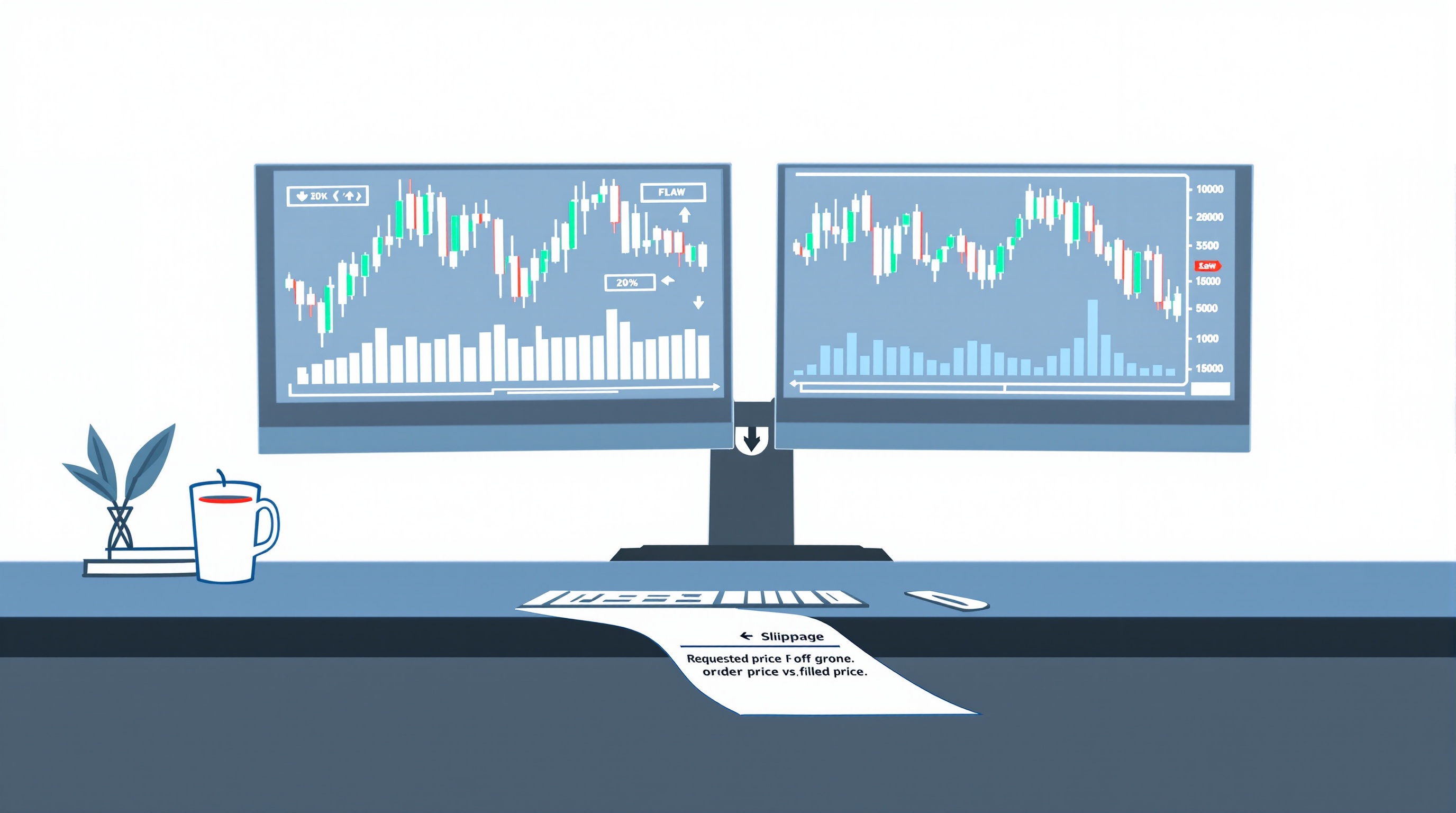
Slippage and execution quality decide whether the price you see on your screen is anything like the price you actually get — and for active traders, that gap can matter more than the spread itself. This lesson is Module 12 of the PipTax FX Trading School, building on the cost concepts from Module 11 (spreads, commissions and swaps); if you haven't covered how brokers price a trade yet, it's worth reading that module first at /school/index.html.
What Slippage and Execution Quality Actually Mean
Slippage is the difference between the price you requested when you hit "buy" or "sell" and the price your order actually filled at. Execution quality is the broader idea: how consistently, quickly and fairly a broker turns your click into a filled position.
Two things drive both:
- Latency — the time between you clicking and the broker's servers processing the order. Even a few hundred milliseconds matters in a fast market.
- Liquidity — how much volume is available at or near your requested price at that exact moment.
Slippage isn't a sign of broker misconduct by itself. Prices move between the moment you click and the moment the order reaches the matching engine — that's just how markets work, especially in fast-moving conditions. What matters for you as a trader is:
- Whether slippage runs roughly symmetric (sometimes for you, sometimes against you), or consistently against you
- How large it typically is relative to your average spread and target profit
- Whether it spikes predictably around news, rollover or thin-liquidity hours, so you can plan around it
None of this shows up on a broker's advertised pricing page — which is exactly why it needs its own lesson.
Market Execution vs Instant Execution
Most retail FX brokers today, including Pepperstone and IG, run market execution as standard. Understanding how it differs from the older instant execution model explains where slippage comes from.
Market execution: - You send an order; the broker fills it at the next available price - No requotes — but the fill price can differ from what you saw, in either direction - This is the dominant model across MetaTrader and proprietary platforms alike
Instant execution (legacy/less common now): - The broker attempts to fill you exactly at the quoted price - If the market has moved, you get a requote instead — a pop-up asking if you accept the new price - No slippage, but potentially more rejected/delayed orders in fast markets
Neither model is objectively "better" — they're different trade-offs between price certainty and fill certainty. What matters is knowing which one your account type uses, since it changes what you should expect to see on your ticket. Check the account specification pages for Pepperstone and IG directly, since execution model can vary by account type and platform (MT4/MT5 vs a proprietary platform).
Where Slippage Comes From: A Practical Checklist
If you want to reduce unnecessary slippage rather than just accept it, work through this checklist:
- News releases — economic data drops (NFP, CPI, central bank decisions) can cause liquidity to briefly vanish, widening slippage on both market and pending orders
- Rollover / end-of-day — the 5pm New York rollover often sees thinner books and wider effective spreads
- Low-liquidity sessions — late Friday, early Sunday open, and public holidays in major FX centres
- Order size — larger orders relative to available liquidity at the top of the book are more likely to "walk the book" and slip
- Connection quality — your own latency (Wi-Fi vs wired, VPS vs home broadband) contributes too, not just the broker's side
- Order type — market orders are exposed to slippage; limit orders aren't, but can go unfilled
None of these are broker-specific criticisms — they apply to trading FX generally, on any FCA-regulated platform.
Measuring Your Own Execution Quality
Don't take anyone's word for execution quality — including ours. Build a simple log:
1. For every trade, record: requested price, filled price, time of day, instrument, and whether news was due within 5 minutes 2. After 2–3 weeks (aim for at least 30–50 trades), calculate the average slippage in pips, separately for news vs non-news windows 3. Compare that average against your typical spread on the same instrument 4. Repeat across account types or brokers if you trade more than one, using consistent conditions each time
This turns "I think my execution is bad" into a number you can actually act on — tightening your trading windows, switching order types, or simply accepting the cost as part of your strategy's edge.
Pepperstone and IG: What to Actually Check
Rather than relying on marketing claims, go to primary sources for each broker:
| Check | Where to look | |---|---| | Execution model per account type | Broker's own account specification pages | | Which MetaTrader servers/platforms are offered | Pepperstone's server list; IG's platform comparison | | Regulatory status | FCA register (both are FCA-regulated, but confirm your specific entity) | | Live spread/commission figures | PipTax's cost tool at /audit.html | | Side-by-side broker comparison | /brokers/index.html |
Pepperstone, for example, offers multiple MetaTrader server routes with different pricing structures — the execution characteristics can differ between them. IG runs its own proprietary platform alongside MT4, and execution on each can behave differently under load. Neither point is a criticism; it's simply a reason to test with your own account type and instrument rather than assume.
Building Slippage Into Your Trading Plan
Once you've measured your own slippage and execution quality, fold it into your plan rather than treating it as background noise:
- Size positions with slippage in mind — a strategy with a tight average profit target is more exposed to slippage eating the edge than one with wider targets
- Avoid trading straight through major news if your log shows a clear spike in slippage during those windows
- Reconsider order types for entries where getting filled matters less than getting a specific price
- Re-test periodically — execution conditions change as liquidity, volatility and broker infrastructure evolve
Slippage and execution quality are a real, measurable cost of trading — not something to be scared of, but something to quantify like any other cost. Combine your own execution log with PipTax's cost tool (/audit.html) and the broker comparison pages (/brokers/index.html) for the full picture, and always remember that trading carries real risk of loss regardless of how good your execution is.
Key takeaways
- Slippage and execution quality is the gap between the price you request and the price you actually get filled at — it can work for or against you.
- Market execution (used by most brokers, including Pepperstone and IG) means your order fills at the next available price; instant execution can requote instead of slipping.
- Slippage tends to widen around news releases, at rollover, and in thin liquidity — plan your trading around these windows rather than fighting them.
- You can measure your own execution quality by logging requested vs filled price on every trade for a couple of weeks and averaging the result.
- Spreads and commissions are only half the true cost of trading — slippage is the other half, and it doesn't show up on a broker's pricing page.
- Use PipTax's cost tool and broker pages to compare live spread/commission data, then build your own slippage log on top of it for the full cost picture.
Frequently asked questions
- What's the difference between slippage and a wide spread?
- The spread is the known, quoted gap between bid and ask at the moment you look. Slippage is the unknown gap between the price you requested when you clicked and the price you were actually filled at, which only appears after the trade executes.
- Is slippage always bad for the trader?
- No. Slippage can be negative (worse than requested) or positive (better than requested). In fast-moving, liquid markets you'll see both fairly often; over hundreds of trades they often roughly offset, though negative slippage tends to cluster around news and low-liquidity periods.
- Do Pepperstone and IG use the same execution model?
- Both are FCA-regulated and use market execution as standard, but the underlying infrastructure differs — Pepperstone offers multiple MetaTrader server routes (e.g. Razor/Standard), while IG runs its own proprietary platform alongside MT4. Execution quality depends on the specific account, instrument and conditions, so check current details on each broker's own pages and test with a demo or small live size.
- Can I avoid slippage completely by using limit orders?
- Limit orders won't fill at a worse price than you set, but they can simply not fill at all if the market moves through your level fast, which is its own cost (a missed trade). It's a trade-off, not a free lunch.
- How much does slippage typically cost over a year of trading?
- It varies hugely by strategy, instrument and broker, so we won't quote a made-up average. The only honest answer is to measure it yourself with a slippage log, which is exactly what this lesson shows you how to do.