Home › FX Trading School › Intermediate
Risk-to-Reward Ratios and Why They Matter
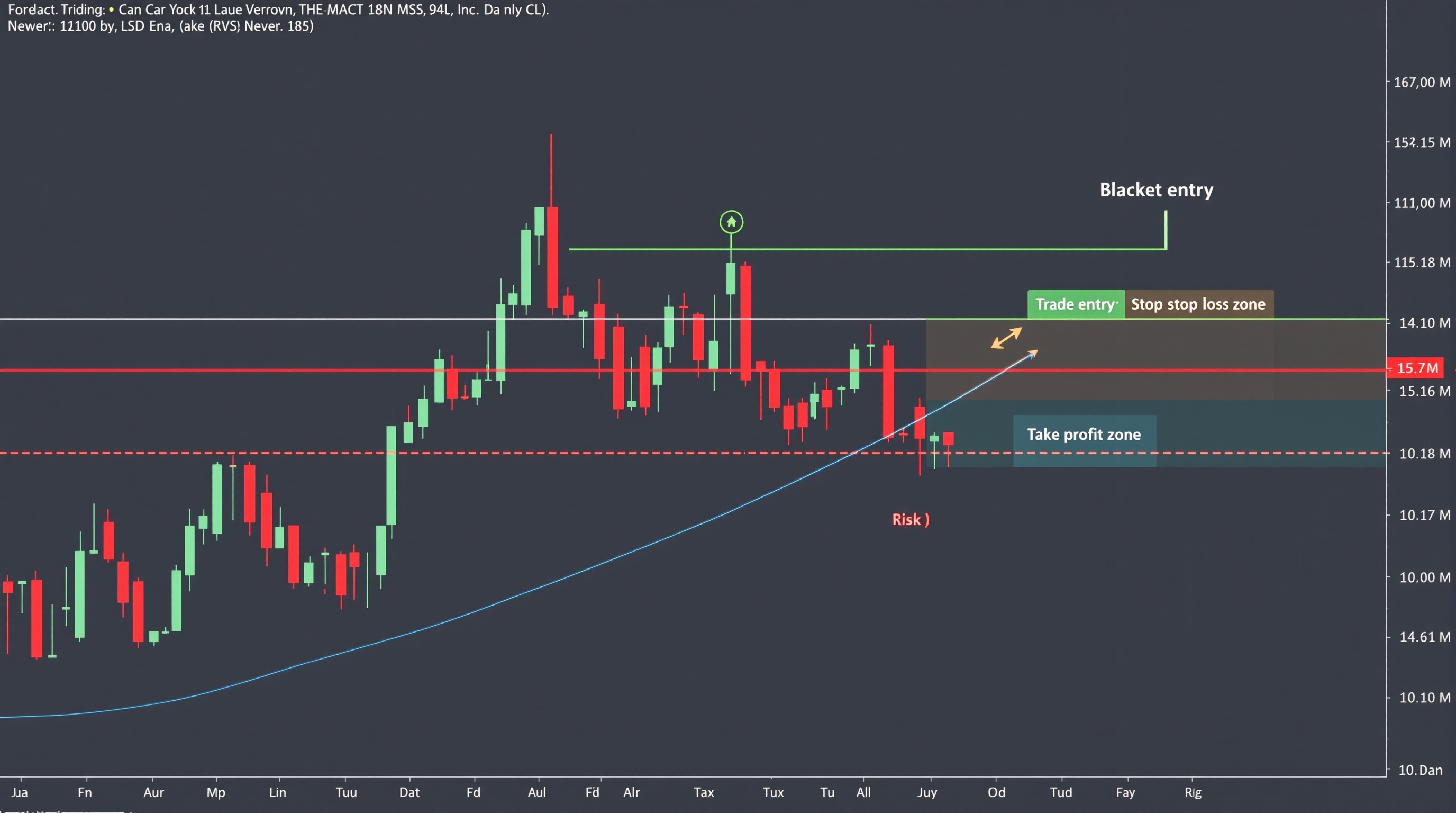
Risk-to-reward ratios tell you, before you ever click "buy" or "sell", how much you stand to lose against how much you stand to gain on a trade — and getting this simple sum wrong is one of the fastest ways to blow up an account. In this Module 8 lesson we'll build on the position sizing and stop-loss placement ideas from earlier in Risk Mastery, and show you how to use risk-to-reward as a genuine filter before you enter a trade, not just a number you calculate afterwards to feel better about a loss.
What a risk-to-reward ratio actually measures
A risk-to-reward ratio (often written R:R) compares the distance from your entry to your stop-loss (your risk) against the distance from your entry to your take-profit (your potential reward).
- 1:1 — you're risking the same number of pips you hope to gain.
- 1:2 — you're risking one unit to potentially make two.
- 1:3 — you're risking one unit to potentially make three.
Say you enter EUR/USD long at 1.0850, place a stop at 1.0800 (50 pips of risk), and set a target at 1.0950 (100 pips of reward). That's a 1:2 ratio. It says nothing about whether the trade will win — it simply defines the shape of the bet before the market decides the outcome.
This matters because most new traders build a trading plan around "will this trade win?" when the far more useful question is "if it wins, is it worth what I'm risking to lose?" A trade with a 90% chance of winning but a 1:0.2 ratio can still lose you money over time. A trade with a 40% win rate and a 1:3 ratio can be very profitable. R:R is the other half of the equation that a bare win rate hides.
Why risk-to-reward matters more than win rate alone
New traders obsess over being "right" — chasing a high win rate — and ignore the fact that profitability is a function of win rate combined with risk-to-reward, not win rate in isolation. This is the core reason risk-to-reward ratios matter so much in a serious trading plan.
The maths is unforgiving. Using a simple expectancy formula:
Expectancy = (Win rate × Average win) − (Loss rate × Average loss)
| Win rate | R:R | Expectancy per trade (in R) | |---|---|---| | 60% | 1:1 | +0.20R | | 40% | 1:1 | −0.20R | | 40% | 1:2 | +0.20R | | 30% | 1:3 | +0.20R |
Notice the last three rows all land at the same expectancy despite wildly different win rates. A trader with a 30% win rate and disciplined 1:3 trades is mathematically in the same place as one winning 60% of the time at 1:1 — but far more resilient to a losing streak affecting confidence, because they only need to be right roughly once in three or four attempts.
This is why professional risk management frameworks lean on R:R rather than boasting about win percentage. It reframes losses as an expected, budgeted cost of doing business rather than a personal failure.
Setting a minimum acceptable ratio before you trade
Once you understand the maths, the practical step is deciding your minimum acceptable R:R before you look at any chart — and refusing trades that don't meet it.
A common approach for intermediate traders:
1. Set a floor, commonly 1:1.5 or 1:2, below which you simply don't take the trade regardless of how good the setup looks. 2. Place the stop-loss first, based on market structure (beyond a swing high/low, outside recent volatility) — not based on how much reward you'd like. 3. Measure the realistic reward to the next genuine resistance/support level, not an arbitrary round number. 4. Divide reward by risk. If it doesn't clear your floor, pass on the trade or wait for a better entry that improves the ratio.
This ordering is deliberate. If you pick your target first and force a stop to fit, you're reverse-engineering a ratio that flatters the trade rather than reflects genuine market risk. Stop placement should always come from price structure and your position-sizing rules covered earlier in this module — not from a desired R:R.
Costs quietly erode your risk-to-reward ratio
Spreads, commissions and swaps aren't just background noise — they eat directly into your realised reward and effectively worsen your ratio on every single trade, especially on shorter timeframes.
Consider a scalp with a planned 20-pip stop and 30-pip target — a 1:1.5 ratio on paper. If the round-trip cost (spread plus commission) on your account is 2 pips, your real target is effectively 32 pips away and your real risk is 22 pips once you account for slippage on the stop. That's no longer 1:1.5 — it's closer to 1:1.45, and on a high-frequency strategy those fractions compound fast.
This is exactly why comparing execution costs matters as much as your entry technique. Pepperstone's Razor account on its MetaTrader servers and IG's own platform have different cost structures — spread, commission, and typical execution — and those differences shift your real-world R:R even when your chart analysis is identical. Rather than guessing, run your actual instruments and typical trade size through PipTax's [cost audit tool](/audit.html) to see how spread and commission translate into pips of ratio lost, and check [/brokers/index.html](/brokers/index.html) for how live account types compare.
Common risk-to-reward mistakes to avoid
- Moving the stop to "give the trade room" after entry — this silently worsens your ratio and abandons your original risk budget.
- Moving the target closer just to lock in a win — this converts a planned 1:2 trade into something closer to 1:0.5 and destroys your long-run expectancy.
- Ignoring costs when calculating the ratio, particularly on tight-stop strategies where spread is a meaningful percentage of the risk.
- Chasing arbitrary round numbers (e.g. always using 1:3) instead of reading what the actual chart structure supports.
- Confusing a good ratio with a good trade. A 1:3 setup on a poor entry with no logical stop placement is still a bad trade.
Building risk-to-reward into your trading plan
Bring it together into a simple, repeatable habit:
- Decide your minimum R:R floor in advance (e.g. never below 1:1.5).
- Place stops using market structure, not wishful thinking.
- Calculate reward to the nearest realistic level, not the furthest optimistic one.
- Factor in spread and commission using your broker's real costs, not estimates.
- Journal every trade's planned vs. actual ratio to spot where discipline slips.
Conclusion: risk-to-reward as a filter, not a formality
Used properly, risk-to-reward ratios stop being a number you calculate after the fact and become a genuine filter that decides which trades deserve your capital at all. Combined with sound position sizing and realistic cost data from tools like PipTax's audit, a disciplined R:R floor is one of the most practical, low-effort upgrades an intermediate trader can make. Trading remains risky and most retail accounts lose money — a good ratio doesn't guarantee a winning trade, but it does mean your wins, when they come, are structurally built to outweigh your losses.
Key takeaways
- <parameter name="key_takeaways">["A risk-to-reward ratio compares your stop-loss distance to your take-profit distance
- defined before the trade's outcome is known."
- "Profitability depends on win rate combined with risk-to-reward
- not win rate alone — a low win rate can still be profitable with a strong R:R."
- "Set a minimum acceptable R:R (e.g. 1:1.5 or 1:2) before you trade
- and place stops using market structure
- not a desired ratio."
- "Spread
- commission and slippage quietly worsen your real-world R:R
- especially on tight-stop or short-timeframe strategies."
- "Never move a stop wider or a target closer mid-trade just to change the outcome — both actions destroy your planned ratio."
- "Use PipTax's cost audit tool to see how your broker's real costs affect the ratio you actually achieve
- not the one on paper."]