Home › FX Trading School › Pro
Risk Management Framework: A Pro-Level Approach
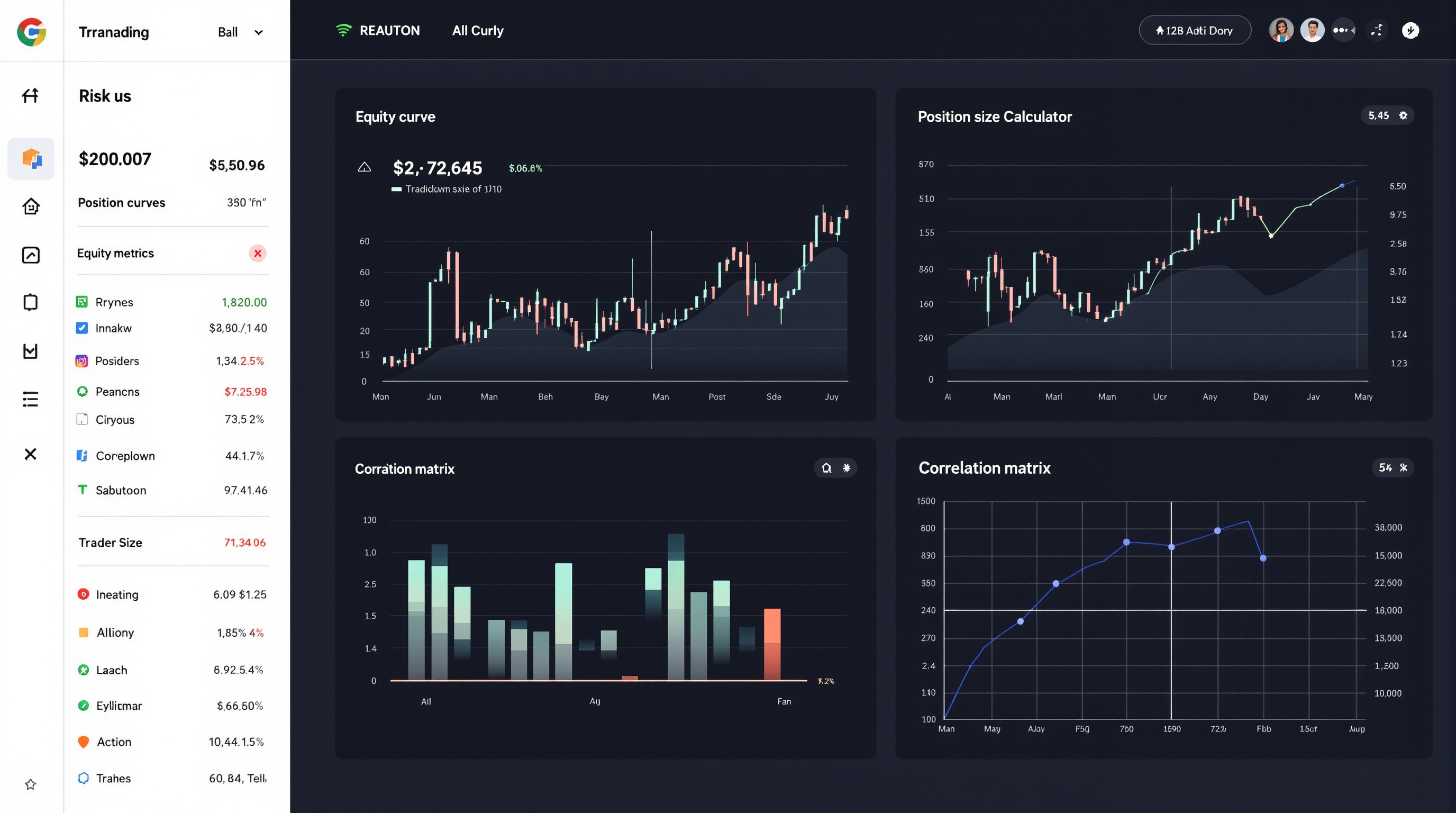
A risk management framework is the difference between trading with a plan and trading with your fingers crossed. This lesson — Module 15 of the PipTax FX Trading School — builds on the position-sizing and stop-loss placement ideas from earlier modules and turns them into a single, written system you can apply to every trade, every day, without having to think it through from scratch each time.
We're not selling a magic formula. Most retail FX accounts lose money, and no framework changes that basic fact. What a proper framework does is control how much you lose, how fast, and whether one bad week can end your account. That's the job.
Why a Risk Management Framework Beats Ad-Hoc Stops
A stop-loss protects one trade. A framework protects the account. If you've only ever thought about risk trade-by-trade, you're missing three things that only show up at the account level:
- Correlation — three "small" trades on EUR/USD, GBP/USD and EUR/GBP longs aren't three independent risks; they can move together and hit your stops at the same time.
- Compounding drawdown — a string of losses shrinks your equity, so a fixed lot size risks a growing percentage of what's left.
- Behavioural drift — after a loss, most traders either revenge-trade bigger or freeze up. A framework removes that decision by pre-committing the rules while you're calm.
A framework is simply the written answer to: *how much can I lose today, this week, and this month, before I stop trading and review what's happening?* Write it down before you need it, not while you're mid-drawdown.
Position Sizing: The Core Calculation
Position size should come from a calculation, not a feeling. The standard formula:
Position size = (Account equity × Risk % per trade) ÷ (Stop distance in pips × Pip value)
Worked example on a £10,000 account, risking 1% with a 20-pip stop:
| Input | Value | |---|---| | Account equity | £10,000 | | Risk per trade (1%) | £100 | | Stop distance | 20 pips | | Max loss per pip | £5 |
That £5-per-pip figure tells you the lot size to enter, not the other way round. Never size the trade first and check the risk afterwards — that's backwards and it's how accounts get blown.
Most brokers, including Pepperstone and IG, offer built-in position size calculators on their platforms or in MetaTrader — use one, don't do this in your head under time pressure.
Setting Daily, Weekly and Monthly Drawdown Limits
Per-trade risk isn't enough on its own. You need account-level circuit breakers that trigger automatically:
- Daily loss limit — e.g. stop trading for the day after losing 3% of equity.
- Weekly loss limit — e.g. stop for the week after losing 6%, and review before the next session.
- Monthly loss limit — e.g. 10%, triggering a full strategy review, not just a pause.
These numbers aren't universal — they depend on your strategy's expected win rate and reward-to-risk ratio — but the principle is fixed: the limit triggers a stand-down, not a discussion. If you're deciding in the moment whether "one more trade" is okay, the framework has already failed. Write the limits into your trading plan and treat hitting one exactly like a broker margin call — non-negotiable.
Correlation and Concentration Risk
Two open trades can look like two units of risk and actually behave like four. Before adding a new position, check it against what you already hold:
- Same-currency exposure — multiple pairs sharing GBP, EUR or USD on the same side of the trade.
- Risk-sentiment correlation — AUD/USD and NZD/USD, or gold and risk-off JPY pairs, often move together in a broad risk-on/risk-off move.
- Sector correlation — indices and the currencies of their home economies can move on the same news.
A simple fix: cap total risk across correlated positions at the same limit you'd apply to a single large trade — for example, no more than 2% of equity across all EUR-exposed trades combined, even if each individual trade only risks 0.5%. This is one of the most common gaps in retail risk plans, and it's the fastest way to accidentally double or triple your intended risk.
Where Trading Costs Fit Into the Framework
Spread, commission and swap aren't just a P&L line item — they compete for the same risk budget as your stop-loss. A framework that ignores costs is incomplete, because costs are a guaranteed loss on every trade before the market has moved a single pip in your favour.
Practical steps:
- Know your round-trip cost (spread plus commission both ways) for the instruments you actually trade.
- Factor swap into any position held overnight — it can turn a marginal win into a net loss over several days.
- Compare your real, live costs across brokers rather than assuming — Pepperstone's raw-spread-plus-commission accounts and IG's spread-only pricing suit different trading styles, and the difference compounds over hundreds of trades.
Run your own numbers through PipTax's [cost audit tool](/audit.html) and check the [methodology](/methodology.html) behind it, then compare options on the [brokers page](/brokers/index.html) before assuming any given account is cheap enough for your strategy.
Building Your Own Framework: A Checklist
Put this in writing, print it, keep it next to your screen:
1. Risk per trade — fixed % of equity, recalculated after every trade that changes your balance. 2. Position sizing formula — calculator-based, never estimated. 3. Daily / weekly / monthly loss limits — with an automatic stand-down, not a judgement call. 4. Correlation rule — a cap on combined risk across related instruments. 5. Cost check — known round-trip cost and swap for every instrument you trade regularly. 6. Review trigger — a fixed point (e.g. hitting the monthly limit) where you stop and reassess the strategy itself, not just the risk settings.
Revisit this checklist monthly — a framework that never changes as your account grows or your strategy evolves is just as risky as having no framework at all.
Conclusion: Make the Framework Non-Negotiable
A risk management framework only works if you follow it when it's inconvenient — that's the whole point of writing it down in advance. It won't turn a losing strategy into a winning one, and it won't protect you from the basic reality that trading FX is risky and most retail accounts lose money. What it will do is stop one bad day turning into a blown account, and stop a string of small mistakes compounding into a large one. Build it before you need it, check your real costs against it using the tools in the [FX Trading School](/school/index.html), and treat every limit as fixed, not flexible.
Key takeaways
- A risk management framework is a written set of rules covering position size, maximum loss per trade, per-day and per-week drawdown limits, and correlation exposure — not just a stop-loss.
- Position sizing should be calculated from your account risk percentage and stop distance, not from a fixed lot size you 'feel comfortable with'.
- Correlated positions (e.g. EUR/USD and GBP/USD longs) multiply your real risk even if each trade looks small on its own.
- Drawdown limits (daily, weekly, monthly) should trigger an automatic stand-down, not a discretionary 'one more trade' decision.
- Trading costs — spread, commission, swap — erode your risk budget over time, so they belong in the framework, not just in your P&L review.
- Most retail FX accounts lose money; a framework won't guarantee profit, but it controls the size and speed of losses when things go wrong.
Frequently asked questions
- What is a risk management framework in forex trading?
- It's a written, rules-based system that governs how much you risk per trade, per day and per week, how you size positions, how you handle correlated trades, and what happens when losses hit predefined limits. It sits above individual trade setups and applies to every trade you take, regardless of strategy.
- How much of my account should I risk per trade?
- Most professional frameworks cap individual trade risk at 0.5%–2% of account equity, with the lower end used by traders running multiple concurrent positions or higher-leverage instruments. The right number depends on your strategy's win rate, average reward-to-risk, and how many correlated trades you might hold at once.
- Does a risk management framework guarantee profits?
- No. Trading is risky and most retail accounts lose money over time. A framework doesn't create an edge — it protects the edge you have (or limits the damage if you don't have one) by controlling position size and stopping you trading on after a run of losses.
- How is risk management different from just using a stop-loss?
- A stop-loss protects a single trade. A framework covers position sizing across all open trades, correlation between them, and account-level circuit breakers like daily or weekly drawdown limits. You can have a perfect stop-loss on every trade and still blow up if you're oversized or overexposed to correlated pairs.
- Do trading costs really matter for risk management?
- Yes. Spread, commission and swap are a fixed drag on every trade before you've made a single pip. Over hundreds of trades, that drag competes with your risk budget for the same account equity, so it's worth checking your real costs with a tool like PipTax's cost audit rather than assuming they're negligible.