Home › FX Trading School › Intermediate
Raw/ECN vs Standard Accounts: Which Costs Less?
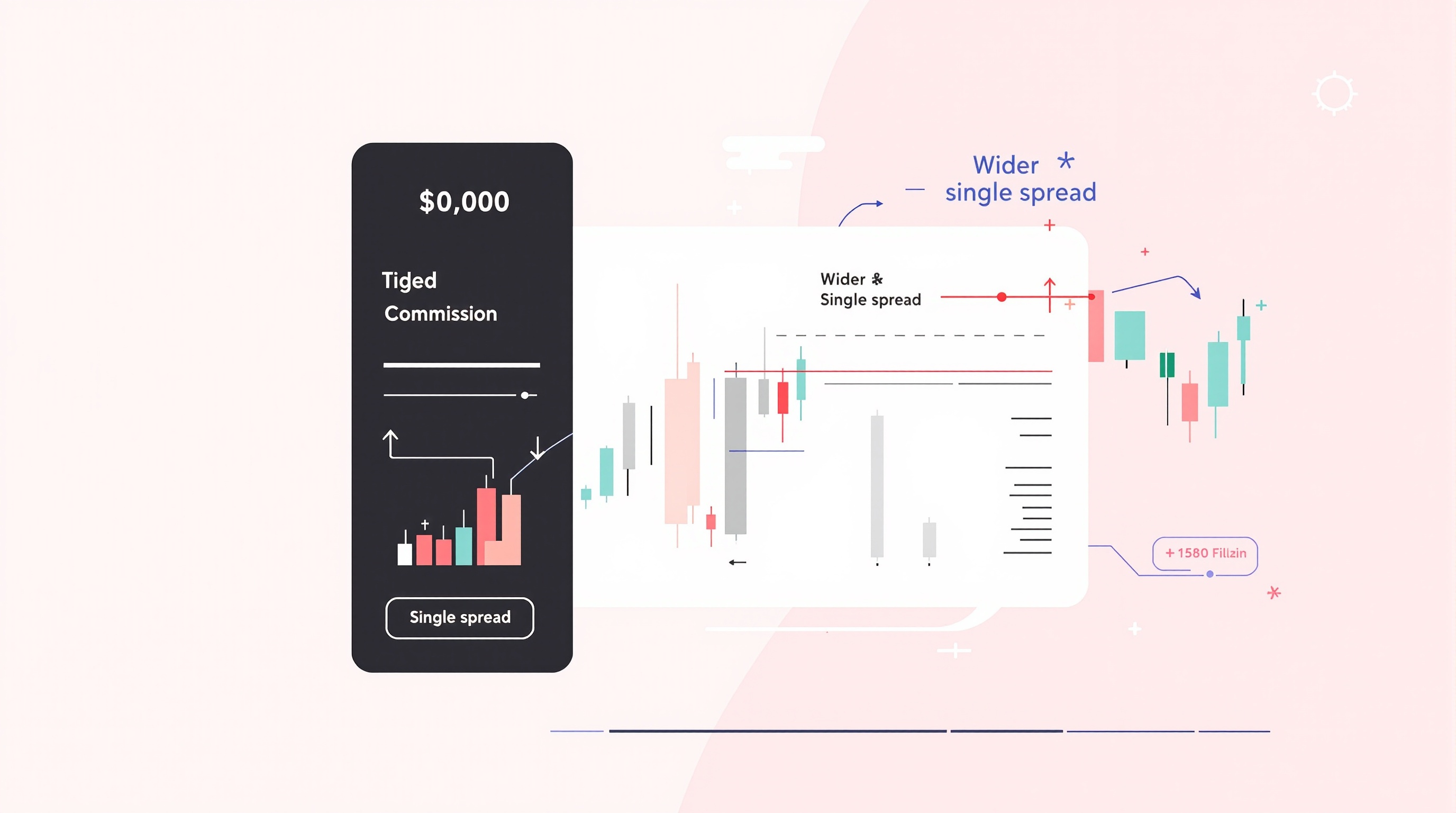
This lesson builds on Module 9's earlier idea of the spread as your entry cost — now we take that further and compare raw/ECN vs standard accounts, because picking the wrong account type can quietly cost you far more than a few pips a month. Once you understand how each pricing model works, you can actually calculate which one suits your trading style instead of guessing.
What "raw/ECN" and "standard" actually mean
These are two different ways a broker packages the same underlying cost — you're never getting execution for free, just labelled differently.
- Standard (or "all-in") accounts: the broker builds its cost into a wider spread. No separate commission line — what you see quoted is what you pay, baked into the bid/ask.
- Raw/ECN accounts (sometimes called "Razor", "Zero", or "Prime" depending on the broker): spreads are pulled closer to the interbank rate — often close to zero on majors during liquid hours — but you pay a separate commission per lot, per side.
Both models can route your order to similar liquidity pools. The difference is presentation and, sometimes, execution style:
- Standard accounts are often built on dealing-desk or hybrid models, common with market-maker style brokers.
- Raw/ECN accounts are usually marketed as direct market access (DMA) or STP, passing orders more directly to liquidity providers.
Neither label guarantees better fills — you're trusting the broker's routing either way, which is why this ties back to the execution-quality lesson earlier in this module.
Why the cost comparison isn't as simple as "commission = expensive"
A common beginner mistake is assuming standard accounts are always cheaper because "there's no commission." That's backwards logic — the commission on raw accounts exists *because* the spread has been stripped down, not on top of a normal spread.
To compare fairly you need the all-in cost per round turn:
1. Spread cost (in pips, converted to your account currency) 2. Plus commission (if any), per lot, both sides of the trade 3. Minus any rebate or loyalty scheme, if applicable
Only once you've added these together can you compare like-for-like. This is exactly the calculation PipTax's [cost impact tool](/cost-impact.html) automates — plug in your typical lot size and trade frequency and it shows the annualised difference between account types.
Where each account type tends to work better
There's no universally "best" model — it depends on your trading frequency and style.
Raw/ECN accounts often suit: - Scalpers and high-frequency traders where every fraction of a pip matters - Traders running EAs that fire dozens of trades a day - Anyone trading large volumes where commission scales predictably
Standard accounts often suit: - Lower-frequency swing or position traders, where a wider spread is paid rarely - Beginners who prefer one simple, all-in number rather than tracking two cost lines - Traders on platforms where commission billing isn't supported (e.g. some spread betting setups)
A worked example of comparing the two
Say you trade one standard lot of EUR/USD, ten times a month. On a raw account you might pay a tight spread plus a fixed commission per side. On a standard account, you pay a single wider spread with nothing else added.
To compare properly:
| Item | Raw/ECN account | Standard account | |---|---|---| | Spread cost | Check live via broker | Check live via broker | | Commission | Per side, per lot | Usually none | | Total per round turn | Spread + commission | Spread only | | Monthly cost (×10 trades) | Multiply total by 10 | Multiply total by 10 |
Never plug in assumed numbers — pull live spread and commission figures from the [brokers comparison page](/brokers/index.html), or better, run your own numbers through the [cost audit tool](/audit.html), since spreads move with liquidity and session.
Pepperstone and IG: two real-world structures worth knowing
You don't need to fabricate numbers to understand the structural difference — just look at how two FCA-regulated brokers organise their offering.
- Pepperstone runs a Standard account and a Razor account side by side on MetaTrader — the Razor account is the raw-spread-plus-commission model, while Standard bundles cost into the spread. Both sit on the same MetaTrader servers, so execution infrastructure is comparable; the pricing model is what changes.
- IG offers its own proprietary platform alongside MetaTrader access, and structures pricing differently again, including spread betting and CFD variants for UK clients. The commission/spread split can differ from a typical ECN setup, so it's worth reading IG's own account documentation rather than assuming it mirrors a classic Razor-style model.
For live, current spreads and commission schedules for either broker, always check their pages directly via the [broker comparison directory](/brokers/index.html) — figures change and shouldn't be assumed from memory.
How to test before committing real capital
Before switching account types, run a structured trial rather than trusting marketing pages.
- Open both account types on a demo (or smallest live size allowed) with the same broker
- Log ten to twenty trades on each, noting spread, commission, and slippage
- Total the real cost per trade and compare to your calculated estimate
- Check consistency — cost during London/New York overlap vs quiet Asian session can differ sharply
- Re-run the numbers through the [cost impact tool](/cost-impact.html) once you have real data, not assumptions
This turns "raw/ECN vs standard accounts" from a theoretical debate into a decision backed by your own trading pattern.
Key mistakes to avoid at this stage
- Assuming raw is always cheaper — at low frequency, commission can outweigh spread savings
- Ignoring commission when comparing spreads — always calculate the combined cost
- Forgetting swap/rollover differences — account types can carry different overnight charges; check the [rates page](/rates.html) rather than guessing
- Not checking regulatory status — confirm any broker you're testing is properly regulated (both Pepperstone and IG are FCA-regulated, which is a reasonable baseline to compare others against)
- Skipping the maths entirely — the whole point of this lesson is that raw/ECN vs standard accounts is a calculation, not a preference
Conclusion
Raw/ECN vs standard accounts isn't about which sounds more "professional" — it's about which combination of spread and commission produces the lowest all-in cost for *your* trading frequency and style. Work out your own round-turn cost using real, current figures rather than assumptions, lean on tools like the [cost audit](/audit.html) and [broker comparison page](/brokers/index.html) for live numbers, and revisit the calculation whenever your trading style changes. Trading costs compound over time, and so does the discipline of checking them properly — remember that trading itself carries real risk, and no account type changes that.
Key takeaways
- Raw/ECN accounts pair a tighter spread with a separate per-lot commission; standard accounts bundle everything into one wider spread.
- Compare account types by adding spread plus commission into a single 'round-turn' cost figure — never judge by spread or commission alone.
- Higher-frequency traders and EA users often benefit more from raw/ECN pricing; lower-frequency swing traders may find standard accounts simpler and cheaper.
- Pepperstone offers Standard and Razor accounts on the same MetaTrader infrastructure; IG structures pricing differently across its own platform and MetaTrader access — check each broker's current figures directly.
- Test both account types with real or demo trades and log actual costs before switching, rather than relying on marketing claims.
- Always verify live spreads, commissions and swap rates via PipTax's cost tool and broker pages rather than assuming figures from memory.
Frequently asked questions
- Is a raw/ECN account always cheaper than a standard account?
- Not always. Raw accounts strip the spread down but add a per-lot commission. At low trading frequency, that commission can outweigh the spread savings. You need to add spread plus commission together and compare the total to a standard account's all-in spread.
- Do Pepperstone and IG offer both account types?
- Pepperstone runs both a Standard account and a Razor (raw-spread-plus-commission) account on MetaTrader. IG structures things a bit differently across its own platform and MetaTrader access, including spread betting and CFD options for UK clients. Check each broker's own account pages for current details.
- How do I calculate the true cost of a raw/ECN account?
- Add the live spread cost (converted to your account currency) to the commission charged per lot per side, then subtract any rebate you're entitled to. That total is your real round-turn cost, comparable directly against a standard account's single spread figure.
- Does account type affect execution speed or slippage?
- Not directly by label alone. Both raw and standard accounts can sit on similar routing infrastructure depending on the broker. What matters more is the broker's actual execution model (STP/DMA vs dealing desk), which you should verify separately rather than assuming from the account name.
- Should beginners start with a standard account?
- Many beginners find a standard account simpler to track since there's one cost line instead of two. But if you're trading frequently or running an EA, it's worth running the numbers on a raw account too, using the cost impact tool, before deciding.
- Do swap/rollover charges differ between raw and standard accounts?
- They can. Overnight financing isn't always identical across account types even at the same broker, so check the rates page for current swap figures rather than assuming they match between account types.