Home › FX Trading School › Beginner
Lots, Units and Contract Sizes Explained
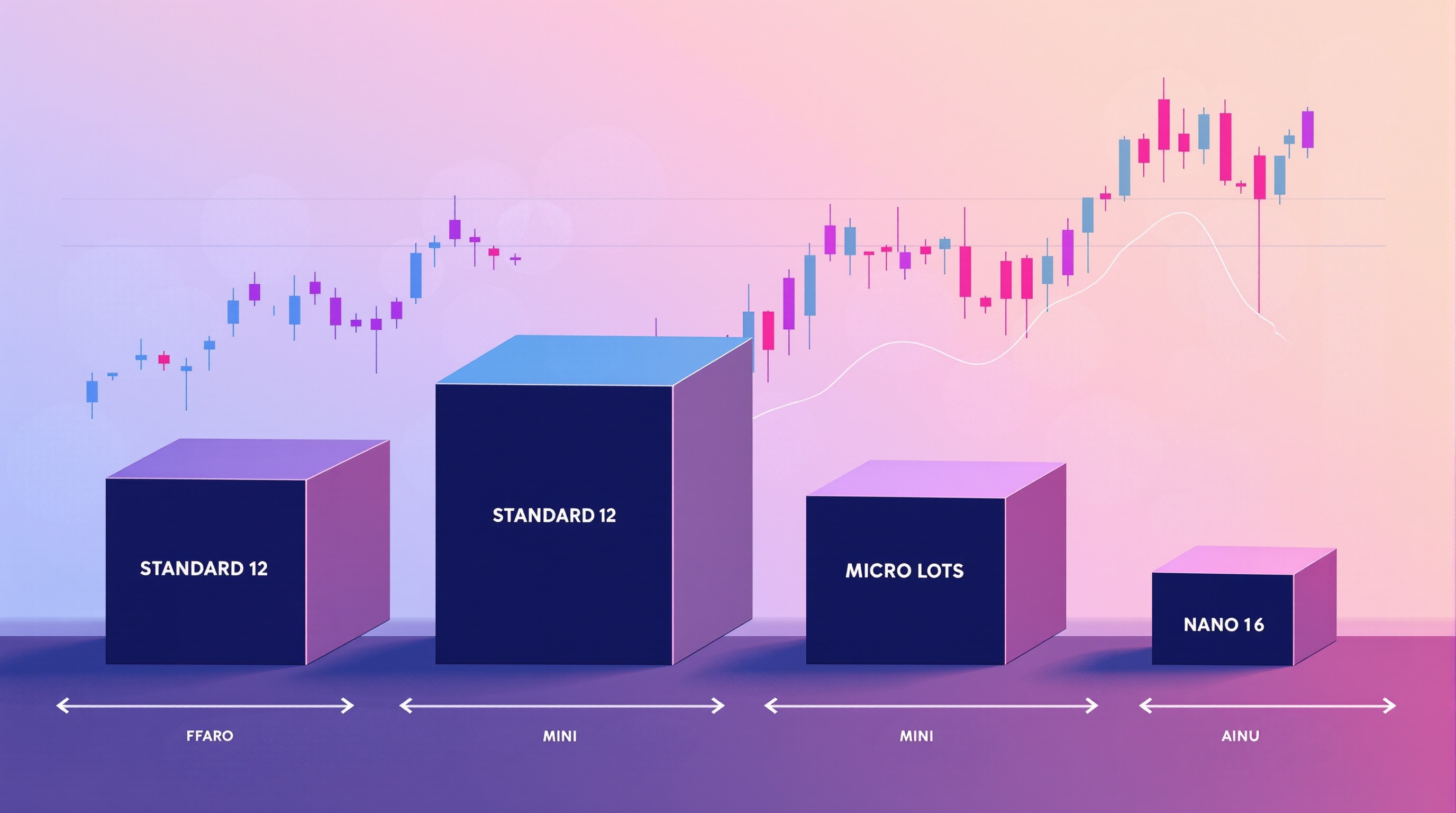
Understanding lots, units and contract sizes is one of the first practical skills you need before placing a single forex trade, because it determines exactly how much currency you're buying or selling and how much each price move is worth in your account currency.
This lesson sits in Module 1 · The basics of the PipTax FX Trading School. If you haven't yet covered how currency pairs are quoted (base vs quote currency), it's worth reading that lesson first, since lot sizing only makes full sense once you know which currency you're actually buying and selling.
What is a lot in forex?
A lot is a standardised trade size used to avoid quoting unwieldy numbers of units every time you place an order. Instead of typing "buy 100,000 euros," you simply select "1 standard lot" and the platform does the conversion. The main sizes you'll meet as a beginner are:
- Standard lot = 100,000 units of the base currency
- Mini lot = 10,000 units (0.1 of a standard lot)
- Micro lot = 1,000 units (0.01 of a standard lot)
- Nano lot = 100 units (0.001 of a standard lot, not offered everywhere)
So if you buy 1 standard lot of EUR/USD, you're controlling €100,000 against the US dollar. Buy 1 micro lot instead, and you're controlling just €1,000. The trade mechanics are identical — same pair, same direction — only the scale changes.
This matters because lot size is the main lever you control to manage risk. Two traders can take the exact same EUR/USD setup and have completely different outcomes purely because one traded 1 standard lot and the other traded 1 micro lot.
Units vs lots vs contract size
These three terms get used loosely, so it helps to separate them clearly:
| Term | What it means | |---|---| | Unit | A single unit of the base currency (e.g. €1 in EUR/USD) | | Lot | A standardised bundle of units (100,000 = standard, 10,000 = mini, etc.) | | Contract size | The number of units one lot represents *on a specific instrument and platform* |
The important nuance for beginners: contract size is not a universal law of physics — it's set by the broker's platform for each instrument. Forex majors typically use the 100,000-unit standard, but indices, commodities and other CFD products often have entirely different contract sizes. Before trading anything new, check the contract specification on your platform rather than assuming it matches forex convention.
Why lot size changes pip value
Once you know the lot size, you can work out pip value — how much money a one-pip move is worth.
Roughly speaking, for pairs where USD is the quote currency:
- 1 standard lot ≈ $10 per pip
- 1 mini lot ≈ $1 per pip
- 1 micro lot ≈ $0.10 per pip
These are approximations for illustration — exact pip values shift with the currency pair and current exchange rate, so don't treat them as fixed. This is exactly why the same 20-pip stop-loss can mean a £2 loss on a micro lot and a £200 loss on a standard lot. The pips moved were identical; the money at stake wasn't.
For live pip values and to see how they interact with spreads and swaps on real instruments, use PipTax's [rates page](/rates.html) alongside your broker's own contract specifications.
Fractional lots on real platforms
You don't need to trade a full standard lot to get started, and in practice most beginners shouldn't. Both Pepperstone and IG — two FCA-regulated brokers commonly used as reference points on PipTax — support trading in fractions of a lot, though the exact minimum size and available increments depend on the specific platform and account type:
- On Pepperstone's MetaTrader servers, order tickets typically let you size trades down to 0.01 lots (a micro lot) on many symbols.
- On IG's own platform, position sizing is often expressed differently (e.g. per point or per contract), so the same concept applies but the input method looks different on screen.
Neither of these is a recommendation — always check the current minimum trade size, contract specification and available increments directly on the platform before trading, since these details can change and vary by instrument.
A simple worked example
Say you want to risk no more than £50 on a trade with a 25-pip stop-loss.
1. Work out pip value needed: £50 ÷ 25 pips = £2 per pip 2. Compare that to standard pip values: roughly 2 mini lots (2 x ~£1/pip) gets you close 3. Adjust using fractional lot sizes if your platform allows finer steps (e.g. 0.2 standard lots) 4. Confirm the actual pip value and contract size on your broker's dealing ticket before submitting
This is the core discipline behind sensible position sizing: you decide your risk in cash terms first, then work backwards to the lot size — not the other way round.
Common mistakes beginners make with lot sizes
- Confusing "1 lot" with "1 unit" — trading 1 standard lot when you meant 1 micro lot is a 100x sizing error, and it happens more often than you'd think.
- Assuming contract size is identical across all instruments — it isn't; check each symbol.
- Ignoring leverage and margin implications — lot size drives margin requirements, which is covered in the next lesson in this module.
- Not checking broker-specific minimums — some accounts have higher minimum lot sizes than others.
- Sizing based on account balance alone, rather than on the size of your stop-loss and your defined risk per trade.
Conclusion: lots, units and contract sizes in practice
Getting comfortable with lots, units and contract sizes is foundational — it's the difference between a trade sized deliberately to your risk tolerance and one sized by accident. Before you place a live trade, confirm the exact contract size and minimum lot increment on your chosen platform, whether that's Pepperstone, IG or another FCA-regulated broker, and use PipTax's [cost impact tool](/audit.html) to see how lot size interacts with spreads, commissions and swaps over time. Trading carries a real risk of loss, and correct position sizing won't remove that risk — but it does mean the risk you take is the risk you actually intended.
Key takeaways
- Lots, units and contract sizes describe how much currency a trade actually controls — not how much cash you need upfront.
- A standard lot is 100,000 units of the base currency; mini (10,000), micro (1,000) and nano (100) lots scale that down.
- Contract size is set by your broker's platform, not a universal rule — always check it on the specific instrument you trade.
- Pip value changes with lot size, which is why the same 20-pip move can mean £2 or £200 depending on how many units you trade.
- Most brokers, including Pepperstone and IG, let you trade in fractions of a standard lot, so beginners don't need to start big.
- Position sizing based on lot size is a risk management tool, not a shortcut to bigger profits — trading still carries real risk of loss.
Frequently asked questions
- What is a lot in forex trading?
- A lot is a fixed unit of measurement for the size of a trade. In forex, a standard lot equals 100,000 units of the base currency. It tells you how much currency you're controlling, not how much money you need to open the trade — that depends on your leverage and margin, which is a separate topic covered later in this module.
- What's the difference between a lot and a unit?
- A unit is a single unit of the base currency — for example, one euro in EUR/USD. A lot is simply a bundle of units. A micro lot, for instance, is 1,000 units. Brokers use lots as shorthand so traders don't have to type six-figure unit sizes for every order.
- How much is a micro lot worth?
- A micro lot is 1,000 units of the base currency — one-hundredth of a standard lot. On most major pairs this makes each pip worth roughly $0.10, though the exact pip value depends on the pair and current exchange rate. Micro lots are popular with beginners because they keep risk per trade small while you learn.
- Do Pepperstone and IG use the same contract sizes?
- Both are FCA-regulated and both use the standard 100,000-unit lot convention as a baseline, but exact contract specifications, minimum trade sizes and available lot fractions can differ by platform and instrument. Always check the contract specification for the exact symbol you plan to trade on their platforms rather than assuming.
- Can I trade less than a micro lot?
- Some brokers and platforms offer nano lots (100 units) or allow custom unit sizes rather than fixed lot steps, particularly on MetaTrader-based accounts. This isn't universal, so check your broker's minimum trade size before assuming you can go smaller than a micro lot.
- Does lot size affect spread or commission cost?
- Yes — spreads are usually quoted in pips but commissions are often charged per lot traded, so the bigger your position, the more the cost in cash terms even though the pip cost looks the same. Use PipTax's cost tool to see how lot size and trading frequency affect your total costs over time.