Home › FX Trading School › Advanced
Latency Arbitrage for Retail Traders: The Honest Truth
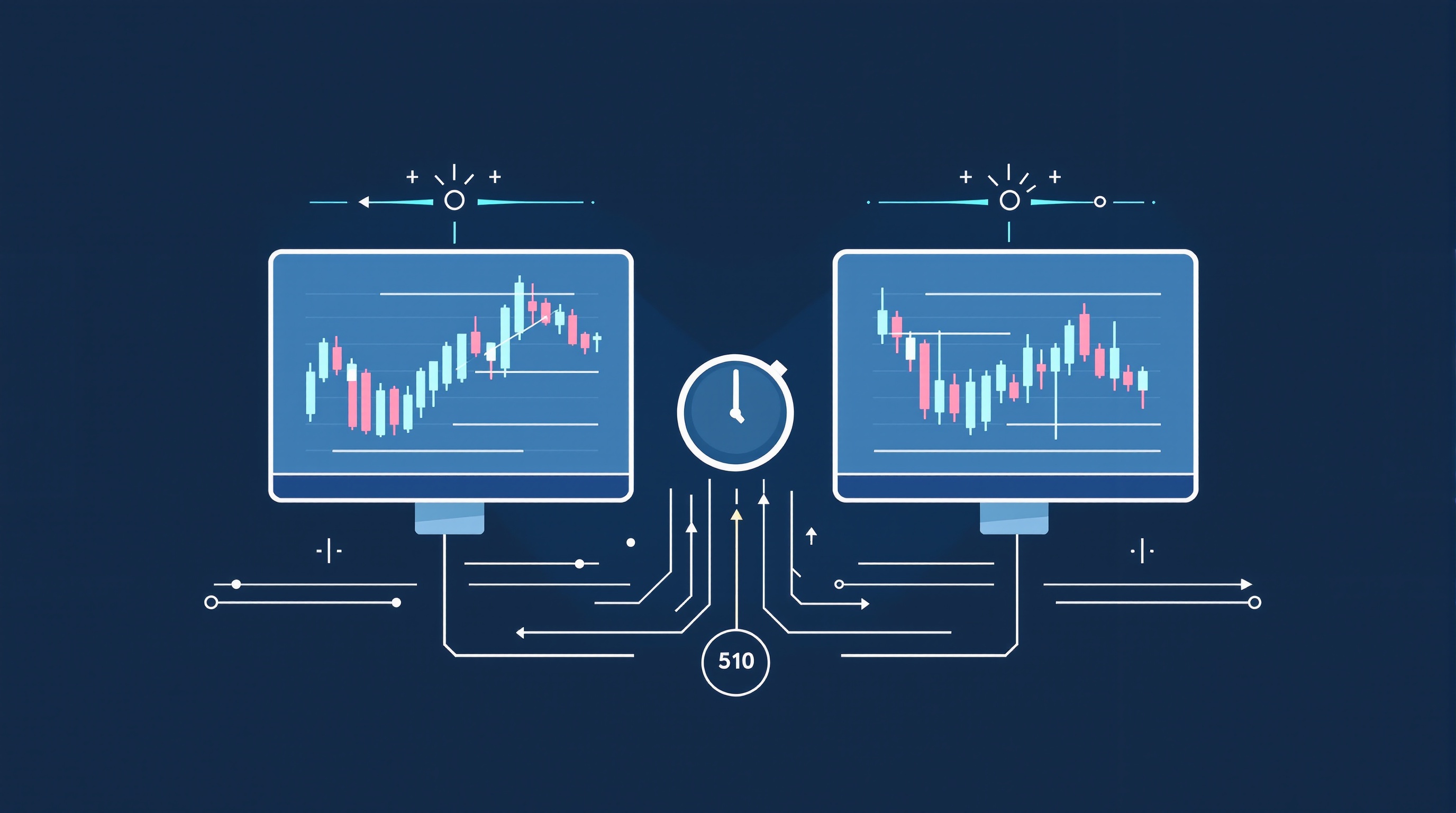
Latency arbitrage is one of the most misunderstood ideas in retail trading, and this lesson exists to clear it up: what it actually is, why it almost never works for individual traders, and what you should study instead if execution speed interests you. This builds on Module 17: Order Execution and Slippage — if you haven't done that lesson yet, go back to it first, because everything here assumes you understand how a broker fills an order and why slippage happens at all.
What Latency Arbitrage Actually Is
Latency arbitrage exploits a timing gap between two price sources. In its classic form:
- A trader has access to a fast, low-latency reference feed (often from an exchange or a prime-of-prime liquidity provider)
- The broker's own pricing engine updates slightly slower, because of network distance, server load, or how it aggregates prices from multiple liquidity providers
- For a brief window — sometimes just a handful of milliseconds — the broker is still quoting the old price after the "true" market has moved
- A sufficiently fast system detects this gap and fires an order into the broker's stale quote before it updates, locking in a near risk-free profit
This isn't a trading strategy in the normal sense. There's no analysis of trend, momentum, or value. It's a market microstructure exploit — profiting from a plumbing delay, not a market view. It's the same underlying idea that drives high-frequency trading arms races on exchanges, just applied to the retail CFD/forex space.
Why It Rarely Works for Retail Traders
The practical barriers are the real story here, and they're bigger than most people selling "arbitrage EAs" will admit:
- Colocation is expensive and technical. Genuine latency arbitrage needs your execution server physically in or near the same data centre as the broker's pricing engine — not a cheap retail VPS in a different country.
- You need a faster independent feed. Without a reference price that updates ahead of the broker's own quote, there's no gap to exploit — you're just guessing.
- Modern brokers have closed the obvious gaps. Firms like Pepperstone and IG run institutional-grade pricing infrastructure specifically designed to minimise stale-quote windows, because arbitrage flow costs them money.
- Execution costs eat the edge. Spreads, commissions, and even tiny amounts of your own connection latency can wipe out a millisecond-scale opportunity before you've hit "buy."
- The maths only works at scale. Genuine arbitrage desks profit from thousands of tiny, near-certain wins. A retail account making a handful of trades a day never reaches the volume needed to make the economics work, even if the technical gap existed.
Put simply: the infrastructure cost and technical skill required exceed what almost any individual retail trader can justify or build.
How Brokers Detect and Respond to Arbitrage Flow
Brokers aren't passive here. Every broker's dealing desk and risk team watches for execution patterns that look like arbitrage, because this kind of flow is classified internally as toxic flow — trades that are profitable for the client specifically because they exploit the broker's own pricing weakness, rather than taking genuine market risk.
Typical detection signals include:
| Pattern | What it suggests to a broker | |---|---| | Trades opened seconds before scheduled price ticks | Feed-timing exploitation | | Very short holding periods with abnormally high win rates | Systematic latency exploit | | Consistent profit clustering around news/liquidity events | Feed-gap targeting | | Orders correlated with a known fast external data feed | Cross-feed arbitrage |
The consequences are spelled out in most brokers' terms of service and can include requotes, execution restrictions (moving you to a slower manual-dealing model), profit voiding, or account closure. This isn't broker paranoia — it's standard risk management, and it applies at both retail-focused firms and institutional ones.
What You Should Study Instead: Real Execution Quality
The genuinely useful skill for a retail trader isn't chasing arbitrage — it's understanding execution quality on the account you actually have, because that's what determines your real trading costs over time. Practical steps:
- Compare spread and commission structures across account types and brokers using PipTax's [cost audit tool](/audit.html) rather than relying on marketing pages
- Track your own slippage and requote frequency over a few weeks of live trading — this tells you far more than any theoretical latency figure
- Understand server location choice. Pepperstone's MetaTrader server list, for example, lets you pick a server region — choosing one closer to your own location reduces your round-trip latency and can modestly improve fill quality, without any arbitrage angle
- Test execution on both platform types. IG's own platform and MetaTrader can behave differently on fills during volatile news — worth knowing before you trade size
- Read broker methodology pages to understand how a firm sources and aggregates its prices — see our [methodology notes](/methodology.html) for how PipTax evaluates this
This is the honest, buildable version of "execution science": not exploiting a gap, but minimising the drag your own execution creates.
A Quick Gut-Check Before You Buy Any "Arbitrage EA"
If you're tempted by a product marketed as a latency arbitrage EA, run it through this checklist first:
1. Does it require colocation or a specific low-latency VPS provider? If not mentioned at all, be sceptical — genuine arbitrage systems are obsessive about this. 2. Does the vendor show verified live results, not just backtests? Backtests can't reliably model millisecond-level fill behaviour. 3. Does the broker's terms of service permit this kind of trading? Check before you deposit, not after your account gets flagged. 4. Is the "edge" explained, or just implied? Vague language ("exploits market inefficiencies") with no technical detail is a red flag. 5. Would it survive scrutiny on a demo account with realistic spread and slippage settings? Test it yourself before risking capital.
Most products fail this checklist within the first two questions.
Conclusion: Latency Arbitrage Is a Concept, Not a Strategy
For nearly every retail trader, latency arbitrage is worth understanding as a piece of market structure knowledge — it explains why brokers build risk controls, why terms of service exist, and why execution quality matters — but it's not a realistic path to consistent profit. The infrastructure, feed access, and scale required sit far beyond retail reach, and brokers actively police the flow patterns it produces. Trading remains genuinely difficult, and most retail accounts lose money even with a sound approach; chasing microsecond edges you can't properly build or maintain adds risk without adding a real advantage. Spend that energy instead on measurable execution quality: compare real costs on [PipTax's broker pages](/brokers/index.html), run your account through the [cost audit tool](/audit.html), and revisit the rest of the [FX Trading School](/school/index.html) curriculum to build the fundamentals that actually compound over time.
Key takeaways
- Latency arbitrage exploits the tiny delay between a fast reference price feed and a slower broker quote — it's a market microstructure trade, not a strategy edge
- It requires colocated servers, direct feed access and sub-millisecond execution that almost no retail trader can build or afford
- Brokers actively monitor for arbitrage patterns and will flag, requote, or close accounts they classify as 'toxic flow'
- Most retail 'latency arbitrage EAs' sold online are either non-functional against modern execution or violate broker terms of service
- The real, usable lesson is understanding execution quality — check spreads, slippage and requotes properly via PipTax's cost tool rather than chasing microsecond edges
- This module builds on Module 17's order execution and slippage concepts — understand those first before studying arbitrage mechanics
Frequently asked questions
- Is latency arbitrage illegal?
- No, it isn't illegal in the way insider trading is. But most retail brokers' terms of service explicitly prohibit exploiting feed latency, and they're entitled to close your account, void profits, or restrict you to manual execution if they detect it.
- Can retail traders realistically do latency arbitrage?
- Practically, no. It requires colocation in the same data centre as the broker's pricing engine, a faster independent reference feed, and execution in single-digit milliseconds. Retail VPS and standard internet connections aren't fast enough, and most brokers have closed the technical gaps that made it possible years ago.
- Why do I see 'latency arbitrage EAs' for sale online?
- Most are repackaged scalping or grid systems with no genuine speed edge, sold using the arbitrage label because it sounds sophisticated. Test any EA on a demo account with realistic spreads and slippage before risking real money, and read the vendor's claims sceptically.
- What's the difference between latency arbitrage and normal scalping?
- Scalping trades short-term price moves you can actually see and react to, using the same feed as everyone else. Latency arbitrage exploits a structural delay in one feed versus another — it's about the plumbing, not the chart pattern.
- How do brokers detect latency arbitrage?
- They monitor for trades placed just before predictable price updates, unusually high win rates on very short holding periods, and patterns correlated with known fast data feeds. This flags accounts for manual review, which can lead to requotes, execution changes, or account closure.