Home › FX Trading School › Pro
ECN vs Market Maker Execution: Module 12 Guide
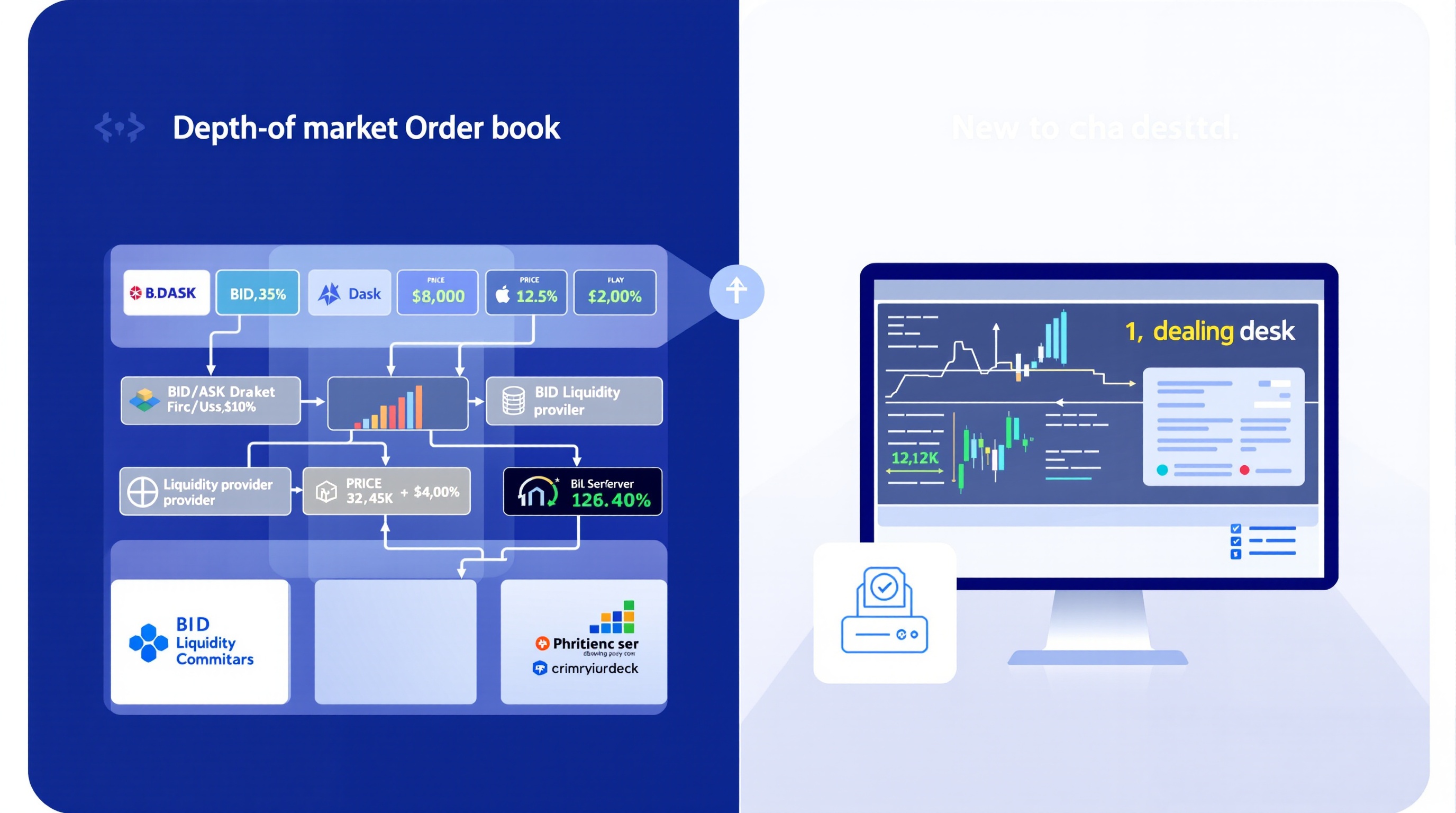
Understanding ECN vs market maker execution matters more once you're past the basics, because your entry model quietly shapes your spread, your slippage, and even whether your strategy is viable at all. This is a Module 12 lesson, so it assumes you already know how spreads and commissions combine into total trading cost (Module 4) and how order types work (Module 7) — here we go one level deeper into *how* your order actually gets filled.
What "execution model" actually means
Every retail forex order has to be matched against a price somewhere. The two dominant models handle that matching differently:
- Market maker (dealing desk): the broker itself is the counterparty to your trade. It quotes you a price, often internally hedges or nets exposure across its client book, and can in theory choose to hold the other side of your position.
- ECN / NDD (no dealing desk): your order is routed to a pool of liquidity providers — banks, non-bank market makers, other brokers — and matched electronically, similar to a stock exchange order book. The broker is a conduit, not the counterparty.
- Hybrid / STP: many brokers blend the two — passing some flow straight through (straight-through processing) while internalising smaller or less risky trades.
None of these labels is inherently "better." A market maker model can offer very tight fixed spreads and simple execution for small retail size; an ECN model gives you visibility into depth of market but usually charges a separate commission. Both Pepperstone and IG offer routes into different models — Pepperstone runs distinct Standard and Razor account types with different execution/pricing characteristics, and IG offers its own platform pricing alongside an MT4 offering — so "which broker is ECN" is really "which account and platform combination is ECN."
How market maker pricing works in practice
A dealing-desk broker sets its own bid/ask, often built from a composite of external feeds plus its own risk model. Key characteristics to know:
- Fixed or near-fixed spreads are more common, which suits traders who want cost predictability.
- No visible order book — you see one price, not the depth behind it.
- Requotes can happen in fast markets if the broker's internal price moves before your order is confirmed.
- Conflict of interest is structural, not necessarily malicious — the broker profits from spread and can be your counterparty, which is exactly why regulation (FCA rules on best execution, client money segregation) and broker reputation matter so much.
This model isn't automatically worse for you. For smaller position sizes, casual strategies, or beginners still building consistency (Module 3 material), simple fixed-spread pricing can actually be easier to plan around than a commission-plus-variable-spread ECN account.
How ECN execution works in practice
On a genuine ECN/NDD setup, your order goes into a matching engine alongside orders from other participants:
- Variable spreads that can go near-zero in calm, liquid conditions — then widen sharply around news.
- Depth of market (DOM) is often visible, showing size stacked at each price level.
- A separate commission per lot is charged, because the raw spread alone doesn't cover the broker's costs.
- Slippage is genuine market slippage, not a dealing-desk decision — your order fills at the next available price in the book, better or worse.
This is why comparing "spread only" between a market maker and an ECN account is meaningless. You must add the commission back in to get a true cost — exactly the calculation the /cost-impact.html tool does for you automatically.
Spotting which model you're actually using
Don't take a broker's marketing label at face value — check the account documentation and platform behaviour:
1. Read the account type description, not the homepage. Pepperstone's Razor account, for example, is explicitly commission-based ECN-style pricing; its Standard account bundles cost into spread instead. 2. Check for depth of market. If your platform shows a DOM ladder with multiple price levels and sizes, you're likely on an ECN/STP feed. 3. Look at the server name in MetaTrader. Broker server lists (visible when you add a new account) usually separate execution types by server, e.g. distinguishing Razor-style servers from Standard servers. 4. Compare spread behaviour around news. Dealing-desk fixed spreads stay flat; ECN spreads typically widen visibly. 5. Check for a commission line on your statement. No commission almost always means the cost is embedded in a wider spread instead.
If you're unsure, run both account types side by side through /audit.html and compare the total cost output.
Execution model and slippage: what to expect
Slippage isn't unique to one model, but it shows up differently:
| Factor | Market maker | ECN/NDD | |---|---|---| | Price source | Broker's internal quote | Aggregated liquidity providers | | Slippage cause | Broker's risk pricing / requote | Real order book movement | | Typical during news | Requote or brief freeze | Wider spread, fast fills | | Visibility | Low (single price) | Higher (DOM visible) |
Neither model eliminates slippage. If your strategy depends on tight, predictable fills around high-impact news, that's a strategy-design question first (position sizing, avoiding news windows) and an execution-model question second.
Choosing the right model for your strategy
Match the execution model to what you actually trade:
- Scalping / high-frequency entries: ECN/Razor-style accounts are usually the better fit — you need real spreads and depth, and the commission is a known, fixed cost you can model.
- Swing or position trading with wider stops: the spread/commission split matters far less relative to your overall move size, so either model can work — cost still matters, just less urgently.
- Beginners still building process discipline: a simple, predictable fixed-spread account can reduce one variable while you focus on entries, exits and journaling.
- Anyone comparing brokers seriously: never compare headline spreads alone. Pull both spread and commission into one landed-cost figure using /cost-impact.html, and cross-check regulatory standing on /brokers/index.html.
Conclusion: test it, don't assume it
The ECN vs market maker execution decision isn't about finding the "honest" model and avoiding the "dishonest" one — both are legitimate, regulated business models, and both can suit different traders depending on strategy and size. What matters is knowing exactly which one you're using, what it costs in total (spread plus commission, not spread alone), and how it behaves under real market stress. Verify your own setup with a demo account, check the account documentation rather than the marketing page, and run the numbers through PipTax's cost tool before you scale up size on any account.
Key takeaways
- ECN/NDD routes orders to a liquidity pool and charges a separate commission; market maker brokers quote their own price and often embed cost into a wider spread
- Neither model is inherently better — match it to your strategy, with ECN/Razor-style accounts usually suiting scalpers and market maker accounts suiting simpler, wider-stop trading
- Always compare total landed cost (spread plus any commission), never headline spread alone, using /cost-impact.html
- Check account documentation, MetaTrader server names, and whether a commission line appears on statements to confirm which model you're actually using
- Slippage occurs under both models but for different reasons: dealing-desk requotes vs genuine order book movement in ECN feeds
- Verify any broker's regulatory standing on /brokers/index.html before assuming either model is inherently safer
Frequently asked questions
- Is ECN execution always cheaper than a market maker account?
- Not necessarily. ECN accounts usually have tighter raw spreads but add a per-lot commission. Once you total spread plus commission, the landed cost can be similar to, or even higher than, a market maker's all-in spread depending on volume and broker. Always compare total cost, not spread alone, using a tool like /cost-impact.html.
- Can a market maker broker trade against me on purpose?
- A market maker can technically be the counterparty to your trade, which is why FCA regulation around best execution, client money segregation and conduct rules matters so much when choosing a broker. Check regulatory status on /brokers/index.html rather than relying on assumptions about business model alone.
- How do I know if my MetaTrader account is ECN or market maker?
- Check the specific account type in your broker's documentation (not just the homepage), look at the server name shown when adding the account in MetaTrader, and see whether you're charged a separate commission line — that almost always signals ECN/STP pricing rather than spread-only market maker pricing.
- Do ECN accounts eliminate slippage?
- No. ECN execution reflects genuine order book movement, so slippage still happens, particularly around news. It's typically more transparent than dealing-desk requotes but not smaller by default — manage it through position sizing and news awareness, not execution model choice alone.
- Should beginners avoid market maker brokers?
- Not automatically. A simple, predictable fixed-spread account can actually suit traders still building process discipline. The priority for beginners should be a properly FCA-regulated broker and a clear understanding of total costs, which matters more at this stage than the execution model label.