Turn a Trading Signal Into a Rule-Based System
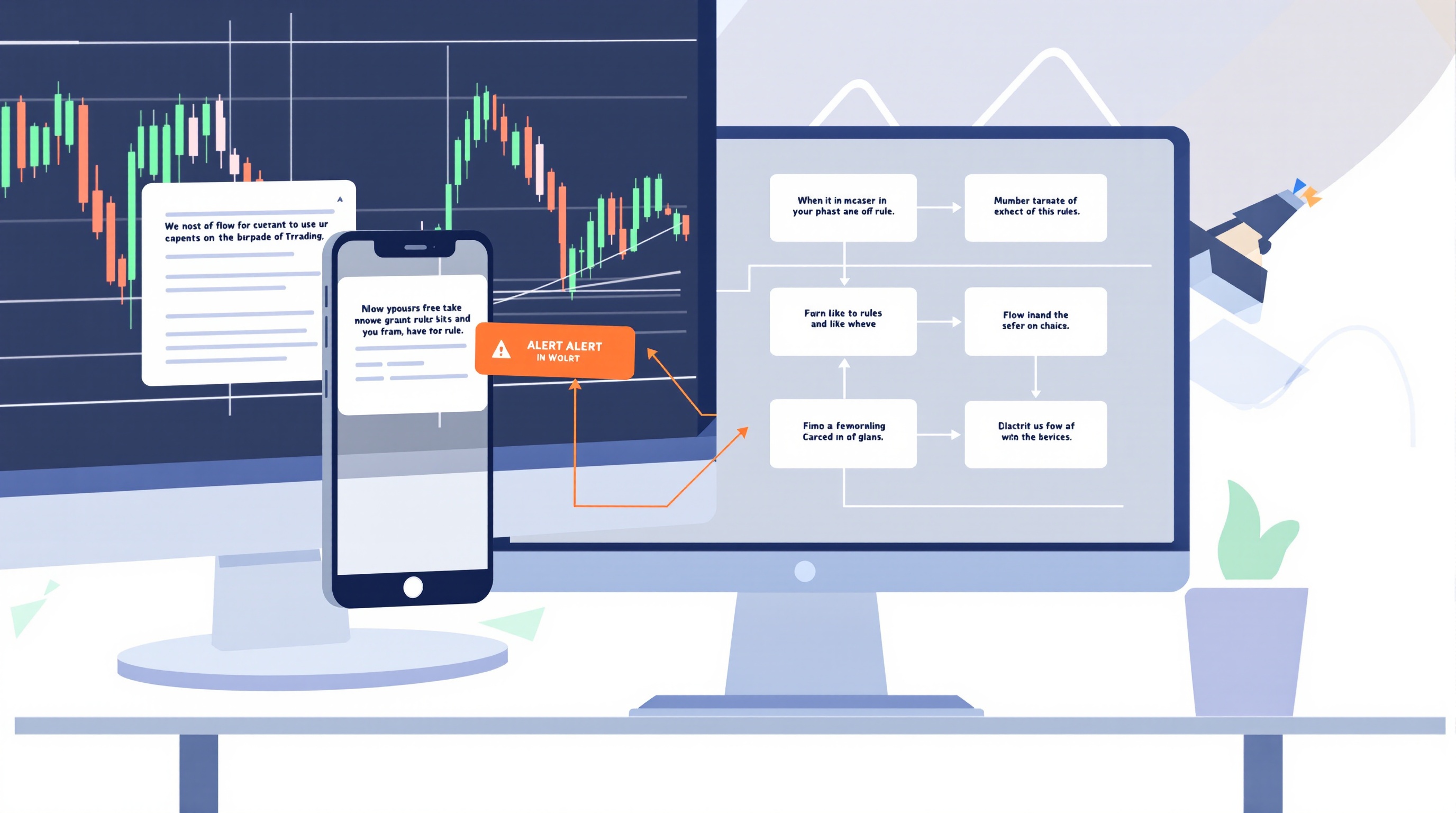
Most traders who follow a signal service are one bad week away from quitting — and the fastest way to fix that is to turn a trading signal into a rule-based system you can test, measure and hold yourself accountable to. A signal is just an opinion with a timestamp; a system is a set of rules that tells you exactly when to act, how much to risk, and when to walk away.
What a Trading Signal Actually Is
A signal is a single instruction — "buy EURUSD at 1.0850, stop 1.0800, target 1.0950" — sent by a person, a bot, or a Telegram group. On its own, a signal tells you nothing about:
- Win rate over time — one good call proves nothing
- Position sizing — how much of your account it assumes you'll risk
- Market conditions it works in (trending vs ranging, high vs low volatility)
- Cost sensitivity — whether the edge survives your actual spread and commission
Signals feel actionable because they're specific, but that specificity is exactly what makes them dangerous to follow blindly. Without a documented rule set behind it, you have no way to know if last month's signals were skill or luck. The job is to reverse-engineer the signal into repeatable logic — entry trigger, exit trigger, risk per trade, and market filter — so you can test it against history and your own cost base before risking a pound of real money.
Step 1: Extract the Rules Hiding Inside the Signal
Before you can test anything, write down the actual decision logic in plain language. For every signal you receive over 2–4 weeks, log:
1. Trigger — what price action, indicator or news event preceded the entry? 2. Timeframe — was this an H1 setup, a daily swing, a scalp? 3. Stop placement — fixed pips, ATR-based, structural (below a swing low)? 4. Target logic — fixed reward:risk, trailing stop, or discretionary close? 5. Session/pair filter — does it only fire during London/New York overlap, only on majors?
If the provider can't or won't explain their logic when asked directly, that's already useful information — it tells you the "system" may just be discretionary calls dressed up as a service.
Step 2: Backtest and Forward-Test Before You Commit
Once you have rules on paper, test them properly:
- Backtest on at least 2–3 years of historical data across different volatility regimes, not just a trending bull run.
- Forward-test on demo for 4–8 weeks minimum to check the rules hold up in live conditions, including slippage and requotes.
- Track sample size — 20 trades tells you almost nothing; aim for 100+ before drawing conclusions.
- Record every trade with entry, exit, spread paid, and commission, not just the win/loss outcome.
Use PipTax's [methodology](/methodology.html) as a template for how to structure this testing process consistently, and lean on the [school](/school/index.html) if you need a refresher on backtesting basics before you start.
Step 3: Build In Risk Rules the Signal Provider Never Gives You
A signal tells you where to enter. It rarely tells you how the trade fits your account. Your rule-based system must define:
| Rule Type | What to Fix | |---|---| | Position sizing | Fixed % risk per trade (commonly 0.5–2%) | | Max daily loss | Stop trading after a set drawdown, e.g. 3% | | Correlation limit | Cap simultaneous exposure to correlated pairs | | Max open trades | Prevent stacking risk across multiple signals | | News filter | Skip entries around high-impact releases if untested |
These are non-negotiable. A profitable-looking signal with no sizing discipline behind it can still blow an account through over-leveraging on a losing streak.
Step 4: Price In Your Real Trading Costs
A rule set that looks profitable on paper can disappear once spread, commission and swap are deducted. This is where most signal followers get caught out — the provider's backtest often assumes zero or unrealistic costs.
- Run your rule set through PipTax's [cost impact tool](/cost-impact.html) to see how spread and commission erode a given strategy's edge over hundreds of trades.
- Use the [audit tool](/audit.html) to check what you're actually paying now versus what's available elsewhere.
- Compare execution models — for example, Pepperstone's Razor account structure versus IG's standard spread pricing — on the [brokers page](/brokers/index.html), since commission-based vs spread-only accounts can materially change a high-frequency signal's viability.
- Check current [rates](/rates.html) for the specific pairs your signals trade, since majors and exotics carry very different cost profiles.
A scalping signal that fires 15 times a day needs a genuinely tight-cost account to survive; a swing signal firing twice a week is far more cost-tolerant.
Red Flags That Mean Walk Away
Be honest with yourself about signal services — most retail traders following paid signals still lose money, and some services are actively designed to extract subscription fees rather than generate returns. Watch for:
- Guaranteed returns or "90% win rate" claims with no verifiable, independently-audited track record
- No public trade history, or only cherry-picked screenshots
- Hidden martingale or grid recovery — doubling down after losses to mask a bad win rate until it blows up
- Pressure tactics — countdown timers, "limited spots," paid Telegram hype groups pushing FOMO
- Vague or shifting rules — the provider can't explain entries consistently or changes the story after losses
- No mention of costs — if spread and commission are never discussed, the numbers are likely inflated
If a service ticks two or more of these, treat it as entertainment, not a strategy.
Turning It Into a System You Actually Trust
To finish the job of turning a trading signal into a rule-based system, write a one-page rulebook: trigger, stop, target, position size, daily loss limit, and cost assumptions. Test it, cost it properly using PipTax's tools, and only then trade it live with real (but small) size. Review every 100 trades and adjust rules based on data, not on the last losing trade. Trading remains risky and no rule set removes that — but a documented system at least lets you measure whether you have an edge, instead of guessing.
Key takeaways
- A signal is a single instruction; a system is documented, repeatable logic covering entry, exit, sizing and market filters
- Extract the hidden rules behind any signal you follow, then backtest over 2-3 years and forward-test on demo before going live
- Add risk controls the signal never includes: fixed % risk per trade, max daily loss, correlation limits and max open trades
- Real trading costs can erase a signal's apparent edge — always check spread, commission and swap using PipTax's cost tools before trusting a backtest
- Red flags include guaranteed returns, no verifiable track record, hidden martingale sizing, and paid Telegram hype pressure
- Most retail traders following signals still lose money; a rule-based system lets you measure an edge honestly instead of guessing
Frequently asked questions
- Can I just follow a signal service without building my own rules?
- You can, but you're trading blind on risk management and costs. Even if you follow someone else's entries, you still need your own position sizing, daily loss limit and cost checks — the provider won't manage your account risk for you.
- How many trades do I need before trusting a signal's track record?
- Aim for at least 100 trades across varied market conditions. Anything under 30 is close to statistical noise, especially if the sample was all from a single trending period.
- Do signal services ever disclose their real costs?
- Rarely in detail. Most backtests understate spread and commission. Always re-check the edge using your own broker's live pricing via the cost impact tool before assuming a signal is profitable after costs.
- Is a martingale-based signal ever safe to follow?
- No system that increases position size after losses to recover a bad win rate is safe long-term — it hides risk until a losing streak causes disproportionate drawdown. Avoid signal services that rely on this, even if recent results look strong.
- What's the difference between a discretionary and rule-based system?
- A discretionary approach leaves entry/exit decisions to judgement each time, which is hard to test or repeat consistently. A rule-based system fixes the logic in advance so it can be backtested, forward-tested and measured objectively.
- Should I use the same account type the signal was tested on?
- Where possible, yes — a scalping signal tested on a low-spread commission account (like Pepperstone Razor) may perform very differently on a standard spread-only account such as IG's default pricing. Check both on the brokers page before committing.